Join Veryst at COMSOL Conference 2026 Boston!
Please join us at COMSOL Conference 2026 Boston, October 7–9, at the Boston Marriott Burlington. We’ll be presenting a sponsored workshop and two posters.
Workshop: Wed, Oct 7, 9:45 a.m. · Open House: Tue, Oct 6, 5–7 p.m.
As a platinum sponsor, we will have a booth at the conference. Our team of Veryst engineers will also be on hand to discuss how we can support your product development. We can help with multiphysics simulation, failure analysis, material modeling and testing, and materials engineering.
We hope you’ll stop by to say hello!
Please also join us the night before, Tuesday, October 6, at our Open House for drinks and light refreshments. For details, RSVP for the Open House.
Where to find Veryst at COMSOL Conference 2026 Boston
Wednesday, October 7 (Day 1)
- Catch up with us at our booth, during the coffee breaks, or reception.
- 9:45 a.m. Workshop: “Using Multiphysics Simulation to Accelerate Product and Process Development.”
- This workshop shows how Veryst has helped clients develop COMSOL Multiphysics® models to solve real product and process challenges. Our clients come from clean tech, chemical processing, consumer products and electronics, medical devices, and pharmaceuticals. As a result, the models shorten development timelines and improve outcomes. For example, attendees will see case studies covering:
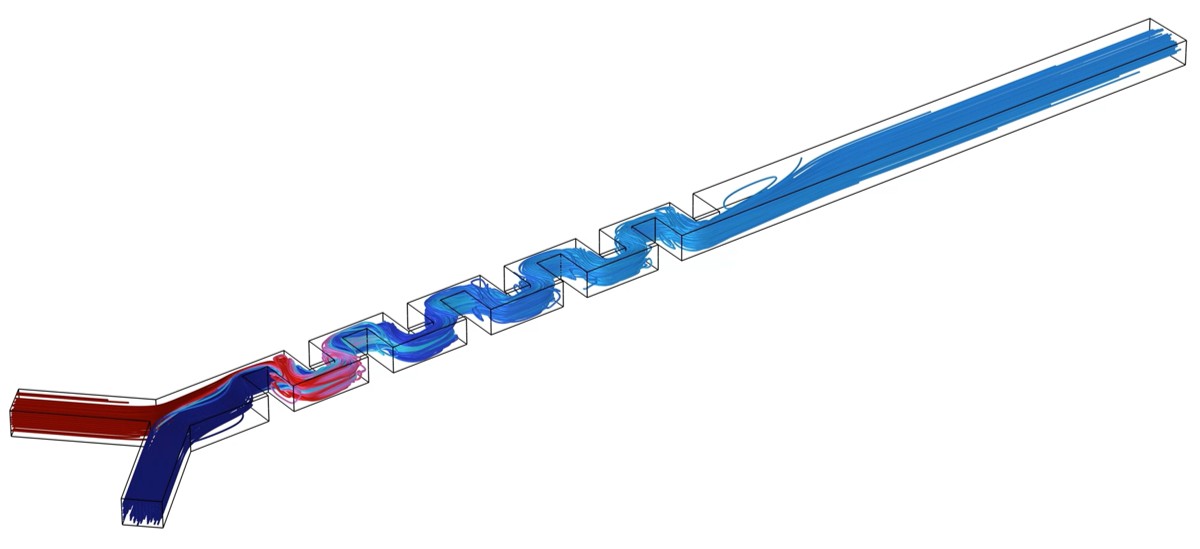
- Multiphase flow behavior in fluidic and inkjet printing systems
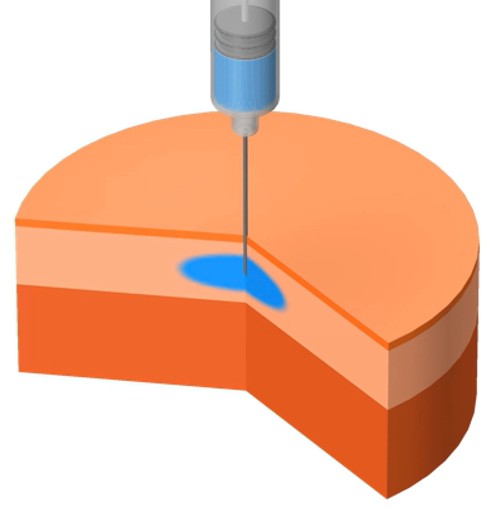
- Subcutaneous and intravitreal injection
- Particle processing technology for consistent product quality
- Thermal management in electronic cooling applications
- The workshop emphasizes practical workflow. First, you’ll see how to build models validated against physical data. Then you’ll learn when a model is ready to inform a design decision. Finally, you’ll see how to build models that stakeholders can trust. Presented by Matthew Hancock, Ph.D., and Mike Kuron, Ph.D.
Presenting posters:
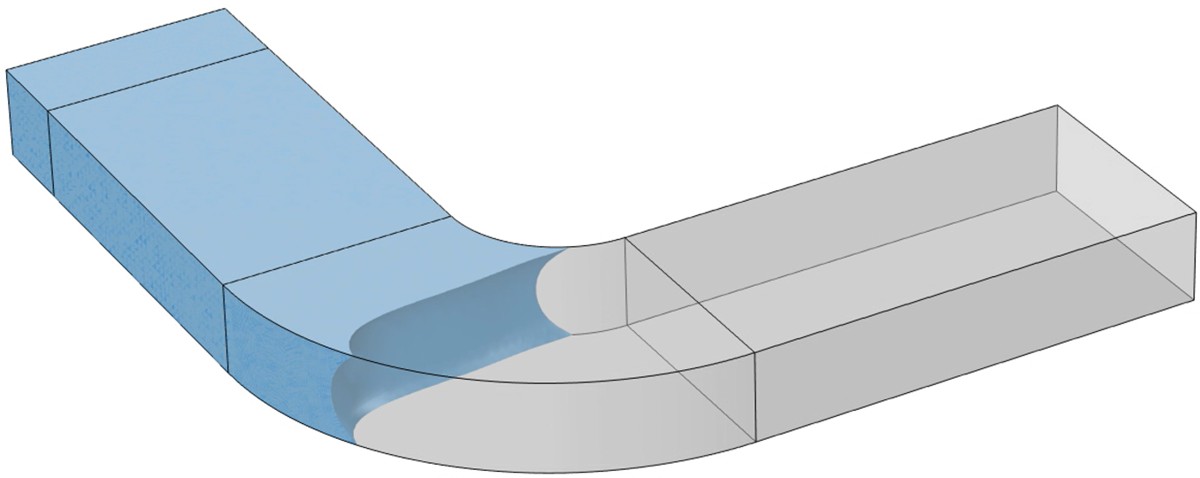
Simulation of Capillary Filling in a Microfluidic Channel — Tianyi Hu, Ph.D. and Matthew Hancock, Ph.D.
- Predicting interfacial dynamics and wettability in COMSOL Multiphysics® supports robust, repeatable design of pump-free microfluidic devices. Applications include point-of-care diagnostics, lab-on-a-chip systems, and other biomedical uses.
- The model couples the Laminar Flow interface with the phase-field method. A custom dynamic contact angle boundary condition resolves the moving air-water interface and contact line.
- Varying the contact angle from 15° to 85° shows how wettability affects filling dynamics. Below ~45°, capillary “fingering” along the channel walls is energetically favorable.
- Filling time increases exponentially with contact angle. It diverges as θ approaches 90°, because the capillary driving force vanishes.
Multiphysics Simulation of Needle-Based Drug Delivery: Subcutaneous and Intravitreal Injection — Matthew Hancock, Ph.D. and Joseph Barakat, Ph.D.
- The subcutaneous model couples Porous Media Flow, Solid Mechanics, and Transport of Diluted Species interfaces. It captures interstitial fluid flow, tissue deformation, and drug dispersion during injection.
- For intravitreal injection, Laminar Flow and Transport of Diluted Species interfaces model delivery into a viscous vitreous humor analog. The model predicts bolus shape, delivery time, and intraocular pressure changes.
- Needle gauge and injection rate strongly influence bolus geometry, delivery time, and injection force. However, experimental validation remains essential because vitreous is viscoelastic and tissue varies from patient to patient.
Learn more at the COMSOL Conference website.