Uniaxial Tension Testing
A uniaxial tension test measures a material’s Young’s modulus, yield and ultimate strengths, elongation at break, and Poisson’s ratio by pulling a specimen to failure. Standard tension tests like ASTM D638, ASTM D412, and ISO 527 are run monotonically to failure at a single strain rate. Veryst frequently goes further — testing at multiple strain rates, incorporating load and unload cycles, and adding stress relaxation or creep periods — to capture the complex, time- and history-dependent behavior of polymers.
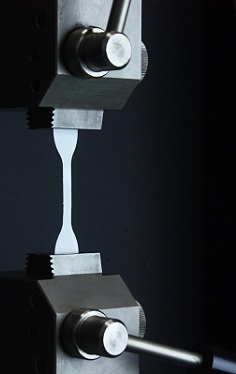
Veryst uses digital image correlation (DIC), a non-contact optical technique that provides full-field strain maps across the specimen and enables accurate strain measurement well beyond 1000% elongation, past the range of a conventional extensometer. A typical test setup for a tension test is shown below as well as a DIC video.
Tests We Perform
Veryst runs both standard, tension tests with customized tests with more complex load histories on thermoplastics, thermosets, elastomers, composite materials, gels, and biomaterials. We custom design test plans using our knowledge of polymer mechanics to capture the complex, time-dependent behavior of polymers, including:
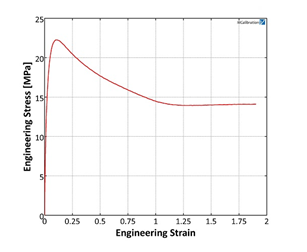
- Monotonic tension tests load a specimen at a constant rate until failure (e.g. ASTM D638, ASTM D412, ISO 527). This is the baseline test for extracting modulus, yield and ultimate strength, and elongation at break, and is usually the starting point for any material characterization program.
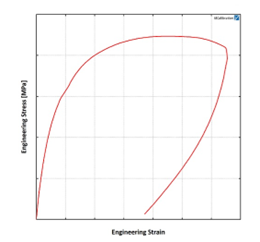
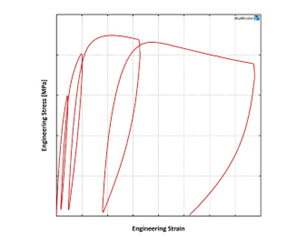
- Cyclic tension tests load a sample to a set stress or strain, then unload the specimen at the same rate. This is repeated at the same value or at successively higher values to measure the non-linear loading and unloading behavior in one test.
- Creep and stress relaxation tests load the sample to a set stress (creep tests) or strain (stress relaxation tests). The stress and strain are then measured over minutes to hours to understand the time-dependent response of the materials.
- Custom tests can utilize any stress or strain history, combining any of the test methods above with changes in rate, to accomplish a load history that is applicable for your material and application.
Temperature Options
These tests can generally be performed at any temperature between -100°C and 300°C. Veryst also performs select tests submerged in liquid nitrogen for material properties at cryogenic temperatures.
Common Questions About Uniaxial Tension Testing
- Does Veryst Follow Standards?
Veryst uses international standards as a guide – some of our tests follow the method exactly, and some test methods are modified to capture more complex material behavior. For example, we test at strain-rates outside the test standard, use complex cyclic load histories to capture large-strain behavior accurately, and use smaller test specimens than those in the standards.
- Can Veryst Test at Non-Ambient Temperatures?
Yes – we perform tests to measure the temperature-dependent response. The data can be used to calibrate a temperature-dependent material model.
We can test in uniaxial tension from -100°C to 300°C, and can perform tests submerged in liquid nitrogen.
- Does Veryst Use Custom Test Specimens?
We use a wide array of methods for specimen creation, from injection molding to machining. We often extract specimens from manufactured parts, and have custom test geometries to measure samples smaller than standards.
- What is digital image correlation (DIC)?
DIC is an advanced, optical strain-measurement technique. DIC enables Veryst to measure the strain without affecting the test results, from microstrains to 1000% strain.
Talk to an Expert About Your Material Characterization Needs
Whether you are selecting a material, diagnosing an unexpected failure, validating a design, or developing inputs for analysis, Veryst can design a test program that targets the properties most relevant to your application. Talk to a Veryst expert about how custom test geometries and fixtures can help you validate your material model and support your product development, qualification, or failure analysis.
We Don’t Just Deliver Solutions; We Explain the "Why" Behind Them
Browse our library of webinars, whitepapers, and blogs to learn more from our experts on advanced simulations, material modeling, and physical model validations.
Fractional R&D for the World’s Most Ambitious Brands
Veryst is the premier product engineering consulting firm for companies that need the highest level of confidence that their products will work in the real world.
We Don’t Just Deliver Solutions; We Explain the "Why" Behind Them
Browse our library of webinars, whitepapers, and blogs to learn more from our experts on advanced simulations, material modeling, and physical model validations.