DNA Electrophoresis Simulation for Nanofluidic Genome Mapping
Technical Challenge
Optical genome mapping relies on straightening out long DNA molecules so their sequence motifs can be imaged and registered against a reference. Nanofluidic mapping platforms achieve this by electrophoretically driving DNA into channels narrow enough to force the naturally coiled molecules to unwind and elongate along the channel axis. How quickly and reliably molecules complete this coil-to-stretch transition is highly sensitive to the field strength, pressure differential, and channel geometry. Unfortunately, empirically testing different channel designs for a set of operating conditions can be both time-consuming and resource intensive. Simulation can quickly search across the design space to improve the likelihood the initial prototypes will perform well, thereby reducing experimental lead times and fabrication costs.
Veryst Solution
Veryst developed a multiphysics simulation of a nanofluidic genome mapping platform – coupling the electric field, fluid flow, and DNA transport – to predict the fractional extension and translocation time of DNA passing through a nanochannel. We compared the performance of different channel geometries – varying the height and width of the nanochannel cross section as well as the taper angle of the entrance and exit regions – at a fixed applied field strength and flow rate.
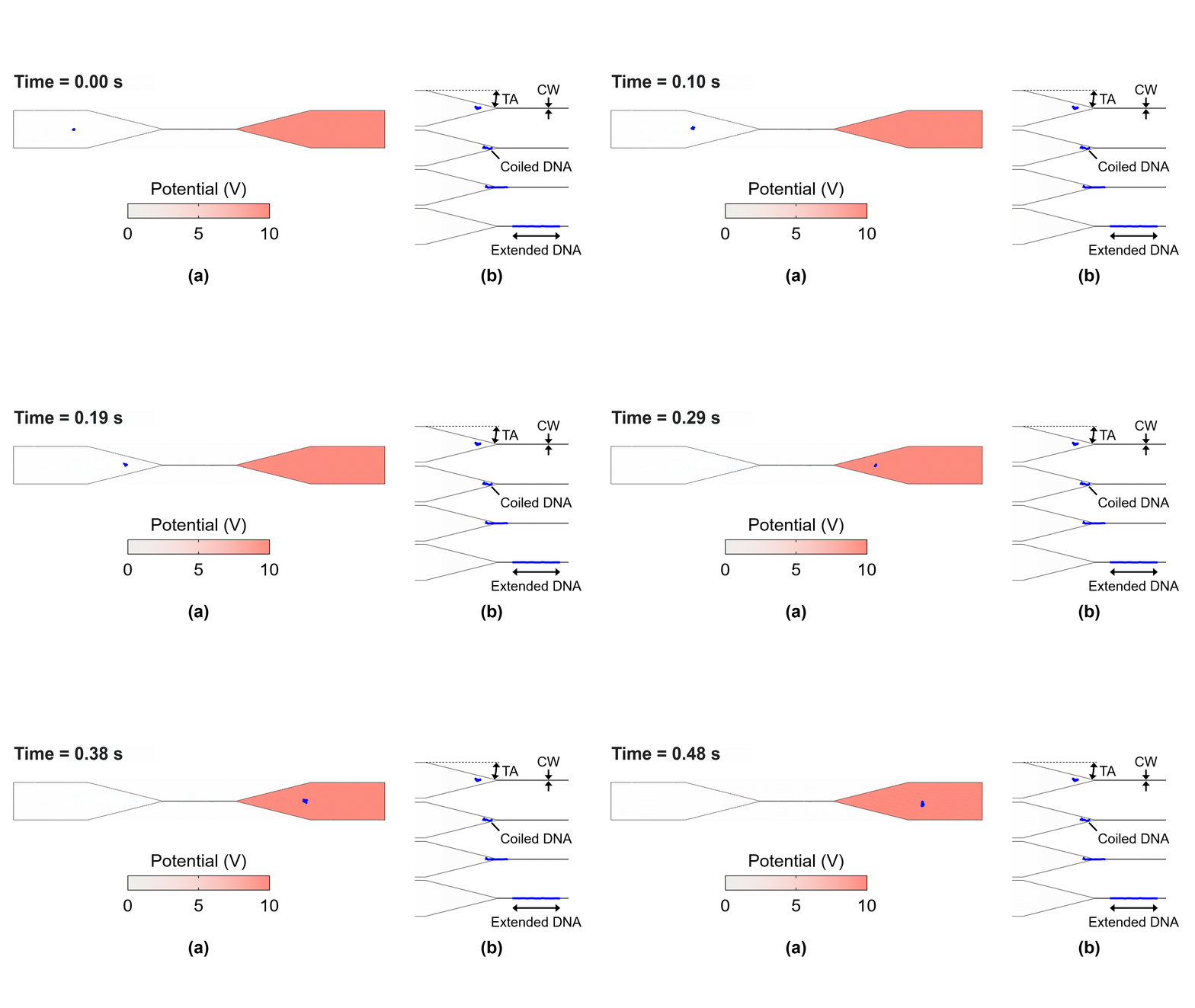
The mapping platform studied here has a typical geometry comprising a nanochannel of square cross section flanked by two tapering sections that connect to wider nanoslits at the entrance and exit (Figure 1). An applied electric field drives the DNA across the channel via electrophoresis (Figure 1a). As the DNA enters the channel, it uncoils and extends (Figure 1b). Because the DNA fluctuates due to Brownian motion, its trajectory and speed vary from one run to the next. Capturing this natural variability meant running many replicates per configuration to build statistically reliable predictions, a task far faster and cheaper to repeat computationally than experimentally.
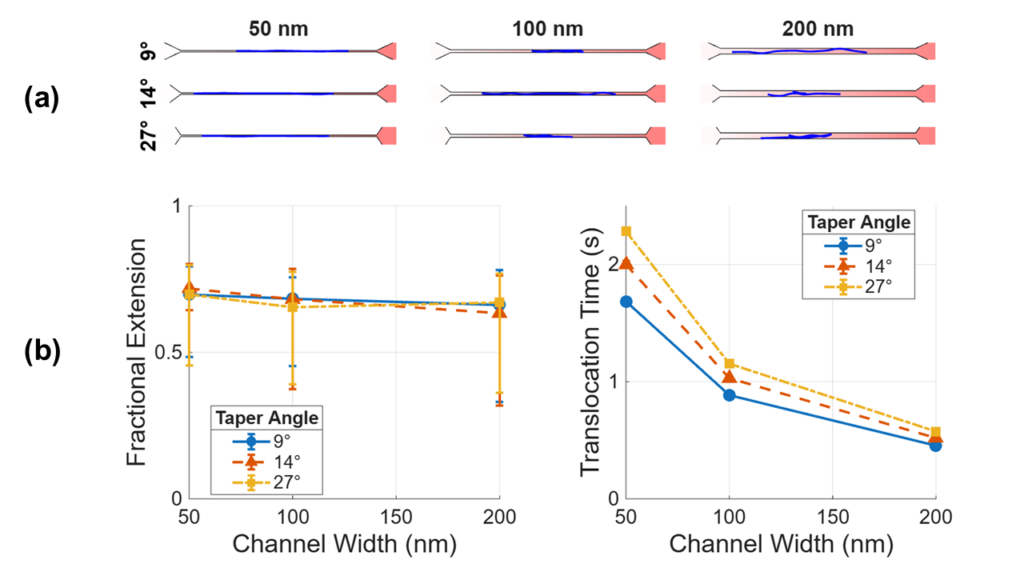
Our simulations predict the fractional extension – the ratio of the extended DNA length to its contour length – and translocation time – the time required for the DNA to travel from the entrance to the exit of the device – for a range of device geometries (Figure 2). We varied the channel width (CW = 50 nm, 100 nm, 200 nm) and taper angle (TA = 9°, 14°, 27°) at a fixed field strength and flow rate (Figure 2a). We employed a Monte-Carlo method to account for the DNA’s Brownian motion, running 100 replicate simulations per configuration. The median and interquartile ranges of the resulting distributions are reported in Figure 2b.
Narrower channels promote slightly higher fractional extension due to the enhanced energetic cost of bending molecular segments, but the dependence is weak and overshadowed by run-to-run variations (Figure 2b, left). On the other hand, wider channels and shallower taper angles increase the likelihood of DNA entering the channel, reducing the translocation time with negligible variance (Figure 2b, right). The tradeoff is significant: tuning channel width and taper angle yields up to a 10% relative increase in the fractional extension on average, but at the expense of nearly doubling the translocation time. This is important insight for designing production-scale platforms for high-throughput mapping while meeting accuracy standards.
Conclusion
Veryst developed a multiphysics simulation of a nanofluidic genome mapping platform, coupling the applied electric field, fluid flow, and DNA transport, to predict the fractional extension and translocation time of DNA across a range of channel widths and taper angles. Using a Monte Carlo method, we were able to build statistically reliable predictions far more quickly and cheaply than an equivalent experimental campaign, narrowing the design space before any prototype fabrication for empirical testing.
The simulations showed that narrower channels can yield up to a 10% increase in the fractional extension on average, but the outcomes vary widely due to the fluctuating trajectories of the DNA. On the other hand, wider channels and shallower taper angles dramatically reduced the translocation time with very little variance. These insights suggest a large tradeoff between throughput and accuracy for optical mapping. This simulation-first approach can guide the design of production-scale nanofluidic mapping platforms, helping engineers weigh DNA extension against throughput according to the accuracy and speed requirements of their application.