Predicting Thinning and Breakup of Viscoelastic Fluids
Technical Challenge
Precision fluid dispensing requires rapid, clean, and predictable breakup of fluid filaments to achieve precise fill volumes at high throughput. Examples abound in modern manufacturing and medicine, from pharmaceutical injection and inkjet printing to additive manufacturing and microelectronics assembly. Poorly controlled breakup leads to inconsistent drop volumes, stringing and satellite droplets, fouled nozzles, and reduced throughput. Predicting and controlling breakup is straightforward for simple, purely viscous fluids comprised of small molecules. However, many industrially and biologically relevant process fluids contain dissolved macromolecules or particulates that impart viscoelasticity, which can make breakup challenging to predict and these failure modes difficult to avoid.
Capillary Breakup Extensional Rheometry (CaBER) is the standard tool for measuring breakup dynamics of complex fluids by generating a thin fluid filament between two parallel plates and tracking its evolution over time. Turning a CaBER measurement into a process-relevant prediction often requires numerical simulation of the complex fluid, which is a challenging task in general. Well-calibrated simulations make it possible to predict breakup times across a wide range of fluid properties and process conditions, complementing physical testing and accelerating decisions during development.
Veryst Solution
Leveraging their expertise in viscoelastic fluid mechanics and rheology, Veryst developed computational fluid dynamics (CFD) simulations of the CaBER experiment to fit nonlinear rheological properties of dilute polymer solutions. The fluid viscosity and relaxation time spectra were calibrated from shear rheometry data from [1]. We validated our simulations using experimental CaBER measurements from [2] and subsequently used to develop correlations between filament breakup times and polymer molecular weight.
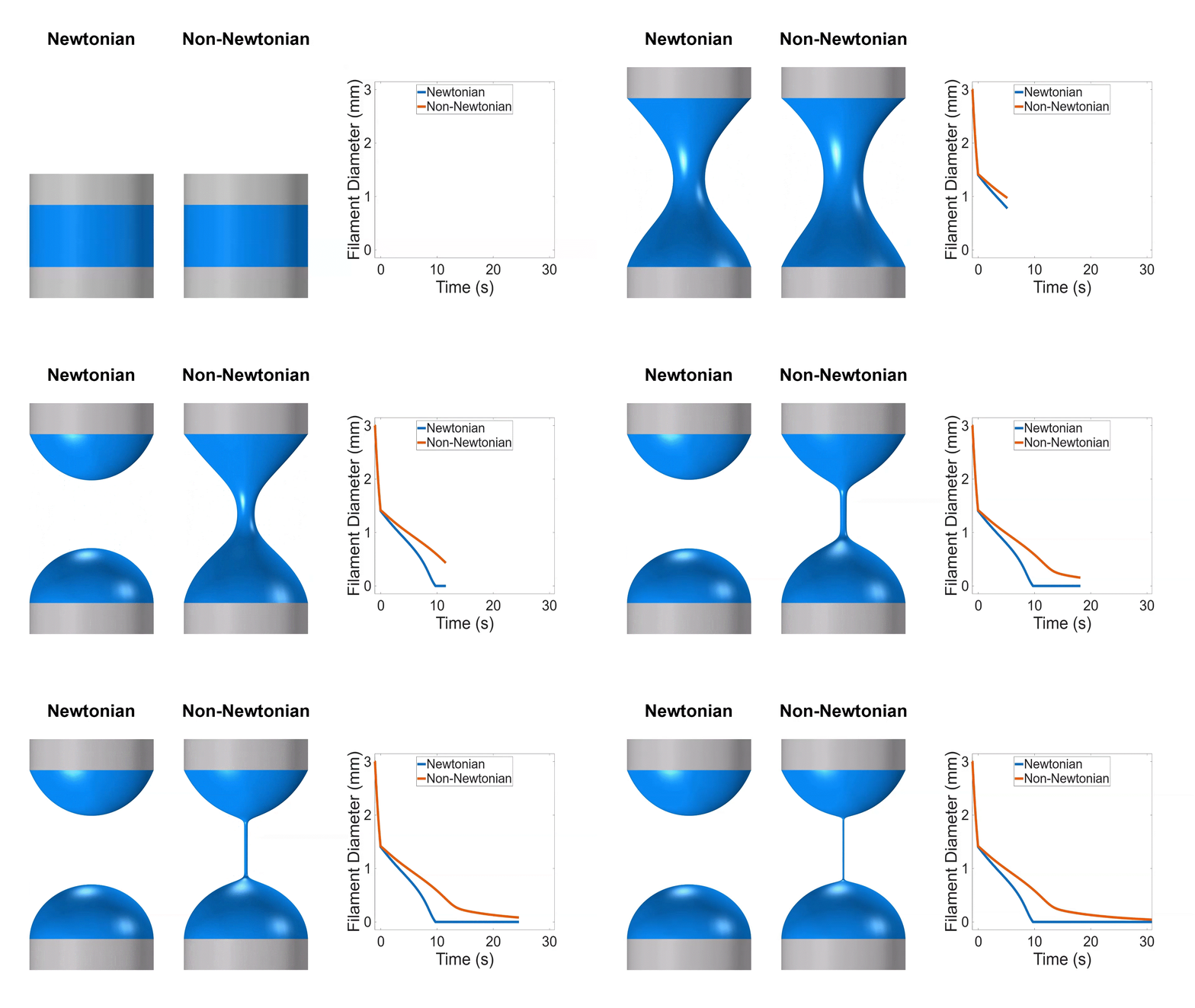
In a CaBER measurement, a fluid is sandwiched between two parallel plates, the plates are extended to a fixed separation to form a filament, and the filament then thins under capillary forces until it breaks (Figure 1). The rate of thinning is governed by the fluid’s relaxation time, which depends on the molecular weight of its constituents – a key parameter for predicting and ultimately controlling breakup behavior.
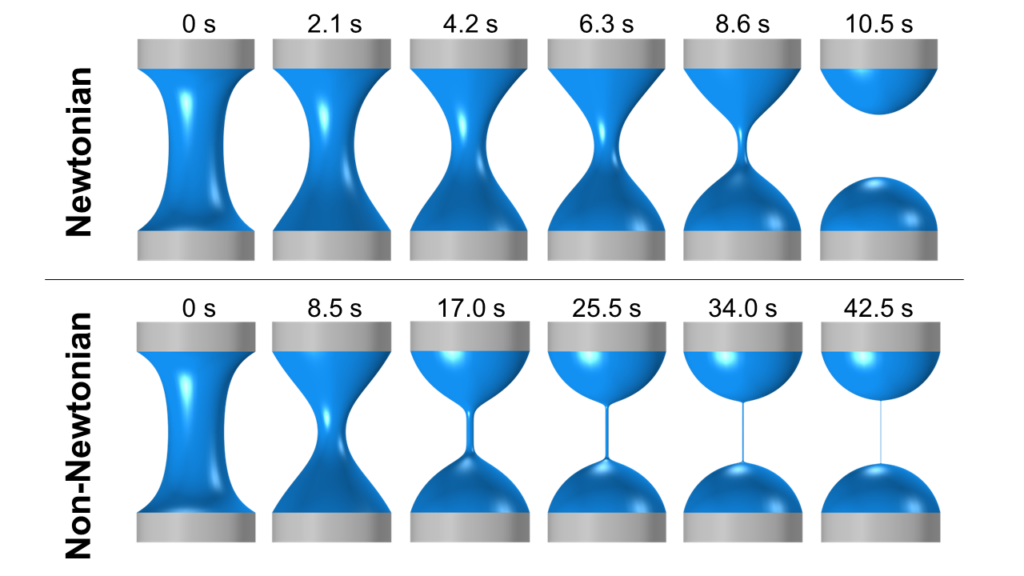
Even a small fraction of dissolved macromolecules can dramatically extend filament lifetime (Figure 2). A dilute (0.05 wt%) solution of 2 MDa polystyrene in styrene oligomer takes roughly 40 seconds to break up (Figure 2, bottom), about four times longer than an inelastic fluid with the same viscosity (Figure 2, top). The reason is elastic recoil: as the filament thins due to surface tension, the stretched polymer chains resist further deformation and pull back against the thinning force, stabilizing the filament far longer than viscosity alone would. Veryst’s CFD simulations accurately capture this effect, predicting the long-lived, cylindrical filaments that are a hallmark of viscoelastic fluids.
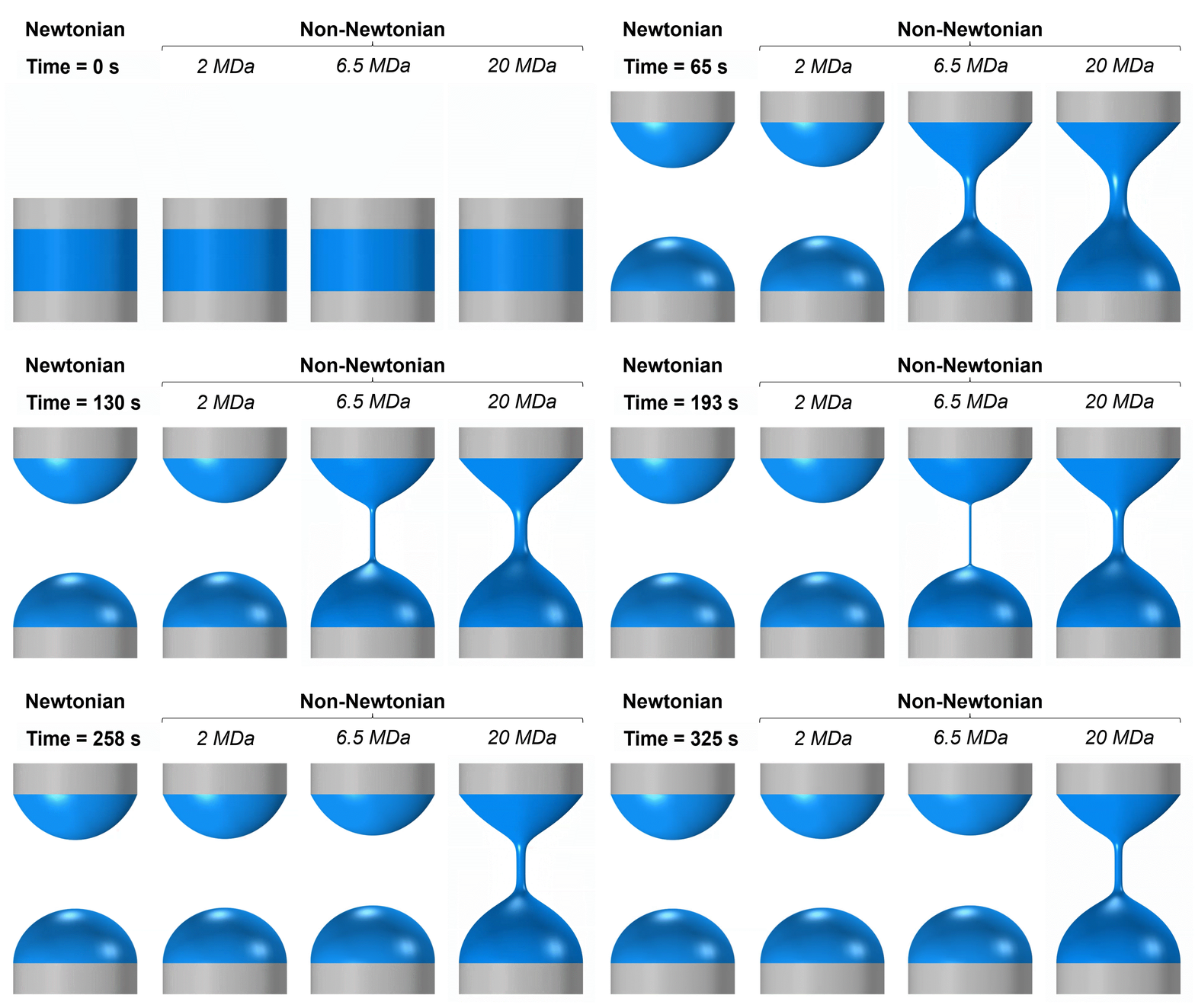
Increasing polymer molecular weight at fixed concentration produces orders-of-magnitude increases in breakup time – a critical insight for process design (Figure 3). Solutions of polystyrene with molecular weight increasing from 2 to 20 MDa yield breakup times ranging from tens of seconds to several minutes, driven by the greater elasticity of longer polymer chains. Molecular weight is not the only relevant factor: solution concentration, polydispersity, and macromolecular architecture all influence breakup behavior, and their relative importance will depend on the application and fluid system in question. Veryst’s simulations can resolve these sensitivities quantitatively, giving development teams a predictive tool to anticipate how changes in fluid composition – whether from batch-to-batch variation or deliberate reformulation – will affect process performance.
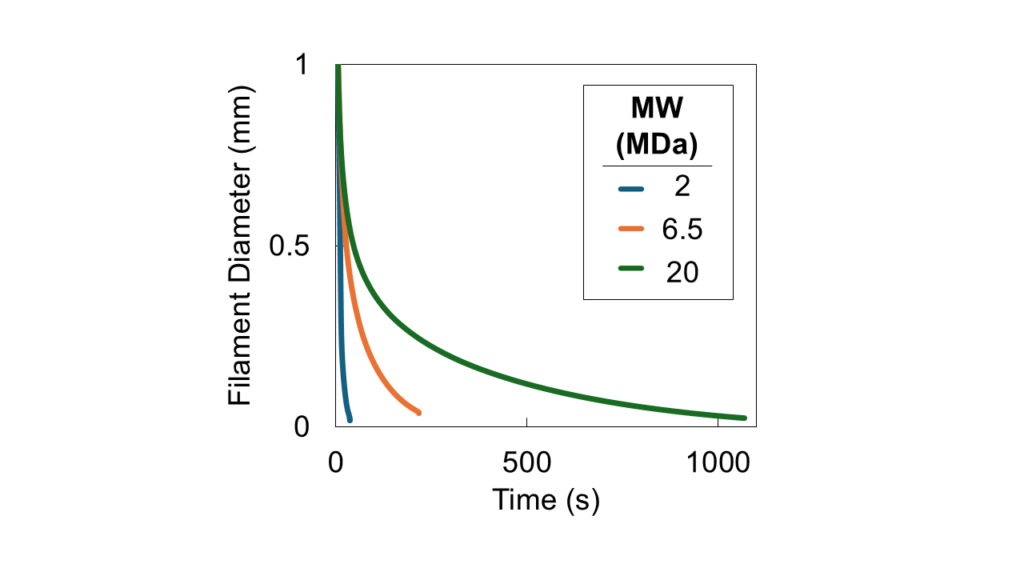
The filament diameter traces in Figure 4 tell the most important story: even small changes in polymer molecular weight can increase the filament breakup time by orders of magnitude. A single calibrated model captures the same behavior reported in literature [2] – direct evidence that the simulations are predictive, not just descriptive. Moreover, Veryst’s CFD framework can reliably extrapolate beyond tested conditions, thereby reducing the need for extensive testing.
Conclusion
Viscoelastic fluid behavior poses real challenges for precision dispensing – but with the right simulation tools, those challenges become predictable and manageable. Veryst’s validated CFD framework captures capillary thinning and filament breakup across a wide range of polymer molecular weights, revealing how small changes in fluid composition can translate into large changes in process performance. Veryst has used simulations like these to help clients reduce long experimental campaigns and identify the root cause of dispensing failures previously dismissed as process variability.
For product development teams working with complex fluids, this means faster iteration, fewer surprises on the line, and greater confidence when scaling from lab to production. Whether the goal is troubleshooting an existing process or designing a new one, Veryst’s expertise in viscoelastic fluid mechanics delivers actionable predictions without requiring an in-house specialist or an exhaustive test campaign.
References
[1] Anna, Shelley L., Gareth H. McKinley, Duc A. Nguyen, Tam Sridhar, and Susan J. Muller. “An interlaboratory comparison of measurements from filament-stretching rheometers using common test fluids.” Journal of Rheology 45.1 (2001): 83-114.
[2] Anna, Shelley L., and Gareth H. McKinley. “Elasto-capillary thinning and breakup of model elastic liquids.” Journal of Rheology 45.1 (2001): 115-138.