High Strain Rate Testing of Polymers
Technical Challenge
Polymeric materials are frequently used in impact applications where strain rates can exceed 1,000/s (i.e. helmets, protective eyewear, enclosures for electronics, etc.). Polymeric materials (thermoplastics, thermosets, elastomers, foams) are strain-rate-dependent. However, there is frequently little to no information about polymer behavior as a function of strain rate.
Furthermore, there are few constitutive models available in commercial finite element codes that are capable of adequately capturing the nonlinear, viscoplastic flow behavior of these materials over the wide range of strain rates needed for simulation.
Veryst Solution
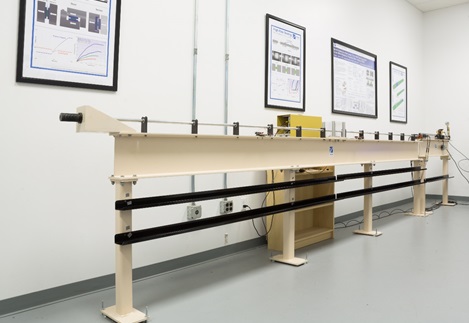
Veryst has developed a suite of experimental and modeling capabilities ideally suited for capturing the high strain rate behavior of polymers. One system, the Split Hopkinson Pressure Bar (SHPB), is commonly used for testing thermoplastic materials at strain rates above 1,000/s in compression. High speed video from an SHPB test on polycarbonate is shown below.
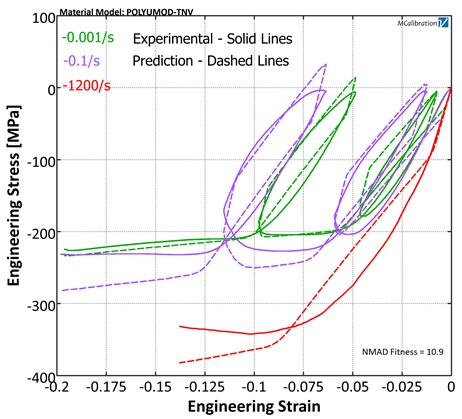
Data from these tests can be combined with traditional uniaxial tests with universal test frames to understand the rate-dependent response of a material.
The data can then be used to select and calibrate and advanced, nonlinear, rate-dependent material model tor use in commercial FE codes. The results are shown here.