Material Model Validation
Veryst offers material model validation services to our clients. Once a material model has been selected and calibrated to test data, Veryst recommends validating the model by performing a test with a stress state different from any used for calibration. This test can be complex and include inhomogeneous deformation, and such a test ensures that the model can accurately represent the material in load cases other than those encountered during the tests. We recommend performing, when possible, a test that is representative of the stress state the product will experience. Some tests we often recommend are:
- Small punch test
- V notch shear (Iosipescu)
- Indentation testing
- Instrumented ball impact test
- Dynamic punch test
- Three- or four-point bending
- Notched tension tests
We often use digital image correlation (DIC) to measure the non-uniform strain fields in the material. The example below shows a shear test used for material model validation.
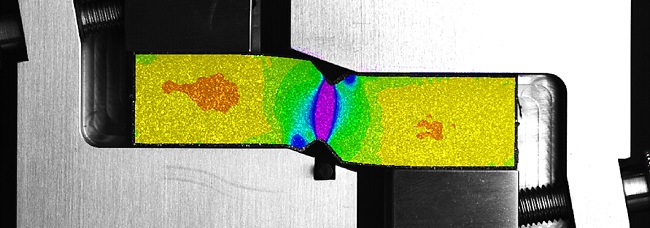 Shear strain contours computed using digital image correlation (DIC) from an Iosipescu (V-notch) test on a thermoplastic material
Talk to an Expert About Your Material Characterization Needs
Whether you are selecting a material, diagnosing an unexpected failure, validating a design, or developing inputs for analysis, Veryst can design a test program that targets the properties most relevant to your application. Talk to a Veryst expert about how custom test geometries and fixtures can help you validate your material model and support your product development, qualification, or failure analysis.
We Don’t Just Deliver Solutions; We Explain the "Why" Behind Them
Browse our library of webinars, whitepapers, and blogs to learn more from our experts on advanced simulations, material modeling, and physical model validations.
Related Case Stories
Put Our Experts to the Test
Our team of scientists and engineers is ready to help you de-risk unproven technologies, explain complex material behavior, and solve your toughest product challenges.
Fractional R&D for the World’s Most Ambitious Brands
Veryst is the premier product engineering consulting firm for companies that need the highest level of confidence that their products will work in the real world.