Small Punch Testing
Engineering materials are typically tested in a uniaxial state of stress as the tests are straightforward; however, many materials exhibit different behavior when loaded under different states of stress. It is therefore important to perform tests beyond the standard uniaxial tension or compression tests to capture fully a material’s response. Biaxial loading is one such state of stress that may be encountered as a component bulges due to internal pressure, for instance.
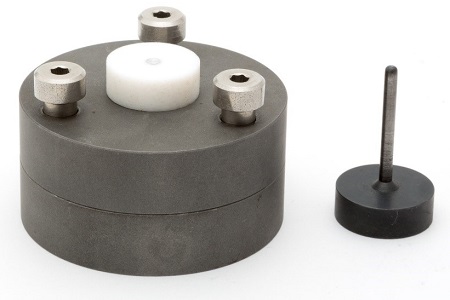
The small punch fixture, shown here, is designed to characterize a material’s behavior under biaxial stress and is based on ASTM F2183. A punch with a 2.54 mm diameter spherical tip is pressed into a clamped thin cylindrical specimen. Punch load and displacement are measured until specimen failure. The results from this test are typically used to characterize the biaxial stress-strain response of a material and to validate a material model developed solely with uniaxial data.
For a customized quotation, please write to us at testing@veryst.com.
We Don’t Just Deliver Solutions; We Explain the "Why" Behind Them
Browse our library of webinars, whitepapers, and blogs to learn more from our experts on advanced simulations, material modeling, and physical model validations.
Related Case Stories
Put Our Experts to the Test
Our team of scientists and engineers is ready to help you de-risk unproven technologies, explain complex material behavior, and solve your toughest product challenges.
Fractional R&D for the World’s Most Ambitious Brands
Veryst is the premier product engineering consulting firm for companies that need the highest level of confidence that their products will work in the real world.