MedTech Engineering Consulting
Specialized expertise, multiphysics simulation, and advanced testing for medical technology development and manufacturing
Bringing a new medical device or drug delivery device to market is hard. Veryst Engineering provides engineering consulting to medical device and technology (“MedTech”), biotechnology (“biotech”) and pharmaceutical (“pharma”) companies to solve their toughest engineering challenges. Whether you are working on an early concept, scaling to production, or maintaining existing product lines, our multidisciplinary team of PhD engineers and scientists combines deep expertise in fluid mechanics, chemical engineering, solid mechanics, and materials science with multiphysics simulation and custom mechanical testing in our own lab.
We ground every engagement in fundamental engineering science and rigorous validation, so you can accelerate development, reduce risk, and bring safer, more effective therapies and devices to patients faster. Browse our MedTech case stories to see examples of our work.
Contact us to discuss how we can help with your MedTech, biotech, or pharma challenge.
Devices and Technologies We Help Bring to Market
Medical devices and technologies succeed or fail on mechanical performance: how precisely they move, how reliably they seal, and how well they hold up through shipping, sterilization, and years of clinical use. Veryst supports device teams from early concept through design verification and regulatory submission. We combine specialized expertise in solid mechanics, materials science & engineering, and fluid mechanics with multiphysics simulation and custom mechanical testing in our own lab. When a design crosses disciplines, we bring in every relevant Veryst expert. We work across the full range of devices and technologies, including:
- Drug delivery devices and combination products, such as autoinjectors, prefilled syringes, and needle-free smart-pills
- Regenerative medicine and tissue-engineered devices that restore organ and tissue function
- Cardiovascular and orthopedic implants, including stents and other structural implants
- In vitro diagnostic and lab-on-chip devices for precise, repeatable fluid handling
- Surgical, interventional, and clinical care equipment, from ablation devices to life-support systems
- Device materials and manufacturing processes, including adhesives and additive manufacturing
Recent Engagements
Examples of our partnerships with MedTech, biotech, and pharma companies range from drug delivery devices to implantable systems.
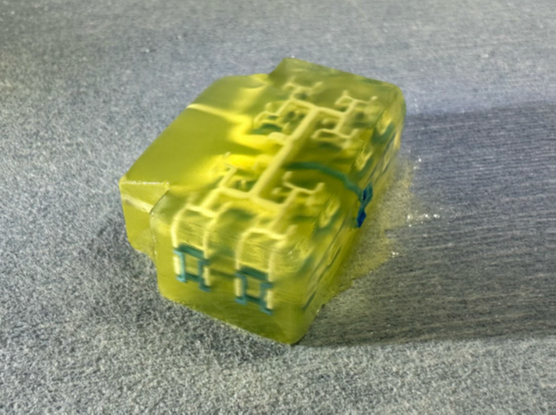
For 3D BioLabs, we supported the development of a 3D-printed, implantable liver device for organ transplantation, led by Dr. Joseph “Jay” Vacanti at Harvard Medical School. We validated 3D-printing reliability for the biomaterial inks and characterized their mechanical properties. Because the underlying material is somewhat brittle, we developed a set of design principles to promote device robustness. We then used fluid mechanics principles and computational fluid dynamics (CFD) to design increasingly complex, fractal-like channel networks that maintain physiological wall shear stresses and healthy blood flow. The collaboration has led to multiple peer-reviewed publications and a granted patent.
For Biora Therapeutics™, we modeled the mechanics behind the BioJet™ needle-free smart-pill platform, a swallowable capsule that fires a high-speed liquid jet to deliver large-molecule drugs without a needle. We built a computational model of device activation, capturing the gas expansion that drives the piston, internal friction losses, and the momentum of the moving parts, then used CFD simulations to optimize jet formation and force across a range of design and operating parameters. The work let Biora iterate faster on the hardware design and reach devices ready for preclinical trials.
For Merck & Co., Inc., we developed and validated a physics-based mathematical model of dual-chamber autoinjector actuation, predicting stopper positions and injection time and flow rate. The model includes our experimentally-derived stopper friction vs. glide speed law. The work was recently summarized in an expert view. Other collaborations with this team include predicting water vapor loss through a needle shield to inform clogging risk, and simulating and experimentally characterizing needle coring.
We packaged our spring-driven dual-chamber autoinjector model into free, web-based apps. These apps predict injection time, flow rate, and stopper trajectory in seconds. Try them at veryst.com/apps.
Relevant industry partnerships:
- 3D BioLabs on an implantable, 3D-printed liver device
- Biora Therapeutics on its BioJet™ needle-free smart-pill platform
- Merck & Co., Inc. on modeling dual-chamber autoinjectors
- Merck & Co., Inc. on simulating needle coring of an elastomeric needle shield
- Merck & Co., Inc. on predicting water vapor egress through elastomeric needle shields of prefilled syringes (AAPS Open)
Types of Projects We Work On
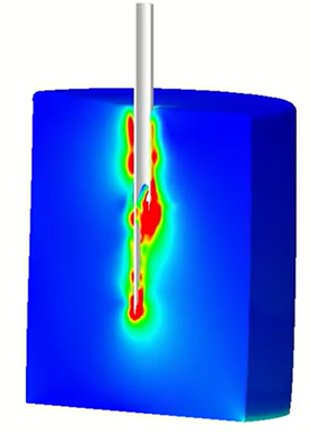
Multiphysics simulation of intravitreal injection.
- Drug Delivery & Combination Products
Developing drug delivery devices and combination products involves both engineering and pharmaceutical challenges. We model how formulations flow through needles, how devices perform across their shelf life, and how design choices affect dose accuracy and patient experience. We also use simulation to perform virtual container closure integrity (CCIT) and drop testing, expediting development by identifying issues early and reducing prototyping and bench testing.
Relevant case stories:
- Regenerative Medicine & Tissue Engineering
Regenerative medicine and tissue engineering aim to replace or restore damaged organs and tissue, from lab-grown constructs to fully implantable devices. These technologies must move fluids, nutrients, gases, cells, and other molecules as effectively as the biology they replace. We model the fluid mechanics, mass transport, and structural behavior of tissue-engineered and cell-based devices, and validate designs against experimental data.
For 3D BioLabs, we supported the development of a platform technology for organ transplantation, led by Dr. Joseph “Jay” Vacanti at Harvard Medical School: a 3D-printed, implantable liver device with an internal vascular channel network. We first validated 3D-printing reliability for the biomaterial inks and characterized their mechanical properties, then used fluid mechanics principles and CFD to design increasingly complex, fractal-like channel networks that maintain physiological wall shear stresses and healthy blood flow. Automating the CAD generation for these intricate geometries also sped up design iteration. The collaboration has led to multiple peer-reviewed publications and a granted patent.
Relevant case stories:
- Cardiovascular & Orthopedic Implants
Implantable devices, including stents, bone screws, and other structural implants, must perform predictably for years. They need to degrade, flex, and contact blood and tissue reliably, robustly, and accurately, as designed. We model the mechanics of bioabsorbable and permanent implants, including degradation behavior and blood-contacting flow. We verify these designs against bench data.
Relevant case stories:
- In Vitro Diagnostics & Lab-on-Chip Devices
Diagnostic and lab-on-chip devices depend on precise, repeatable fluid handling at very small scales. Mixing, bubbles, contamination, and surface geometry and chemistry can all affect assay accuracy. We simulate flow, transport, and mixing in microfluidic channels, wells, and pumps. This helps diagnostic device development teams get repeatable, sensitive results.
Relevant case stories:
- Fluid flow through porous media
- Chaotic mixing in microfluidic devices
- Reagent dry-down in a microwell
- Active mixing in a microwell by repetitive pipetting
- Concentration gradients in a microfluidic device
- Chemical carryover in a microfluidic device
- Delamination in microfluidic valves
- Bubble entrapment in microchannels
- Modeling and simulation of low-voltage cascade electroosmotic pumps
- Laminar static mixer analysis
- Surgical & Clinical Technology
Surgical, interventional, and clinical care equipment must perform reliably under demanding conditions, whether in the OR or at the bedside. This includes ablation devices, insufflators, osteotomes, grippers, and life-support systems. We model the thermal, acoustic, and mechanical behavior of these devices. This supports design validation and patient safety.
Relevant case stories:
- Device Materials, Manufacturing & Reliability
Materials and manufacturing choices determine whether a device survives assembly, shipping, and years of use. This includes adhesives, additive manufacturing, and plastic components. We characterize materials and simulate failure modes to catch reliability issues before they reach the field.
Relevant case stories:
- Adhesively joining difficult materials with corona plasma treatment
- Adhesive cure troubleshooting with differential scanning calorimetry (DSC)
- Optimizing additively manufactured parts for adhesive assembly
- Additively manufactured lattices
- Strength of additively manufactured parts
- Fatigue failure of a plastic lever
- Plastic clip failure
- Impact fracture toughness of adhesive joints
Contact us to discuss how we can help with your MedTech, biotech, or pharma challenge.
Biora Therapeutics™ and BioJet™ are trademarks of BT Bidco Inc., dba Biora Therapeutics.
Frequently Asked Questions
- Does Veryst only work on drug delivery devices, or other kinds of medical devices too?
Veryst works across the full range of medical devices and technologies — drug delivery and combination products, cardiovascular and orthopedic implants, diagnostic and lab-on-chip devices, surgical and clinical equipment, and the materials and manufacturing processes behind them. See Devices and Technologies above for the full list.
- Does Veryst only run simulations, or does it also handle physical testing and missing material data?
Both. Veryst pairs multiphysics simulation with custom mechanical testing in its own lab, and when material properties are missing, Veryst runs the test plan needed to collect them directly rather than relying on spec sheets.
- Can Veryst help with regenerative medicine or tissue-engineered devices that aren't yet an approved product?
Yes. Veryst supported 3D BioLabs from early concept through to a patented, 3D-printed implantable liver device, well before any regulatory submission — see Regenerative Medicine & Tissue Engineering above.
- Which companies has Veryst worked with, and has any of this work been published or patented?
Most of Veryst’s client work is confidential. Veryst has publicly partnered with Merck & Co., Inc., Biora Therapeutics, and 3D BioLabs. That work includes a granted patent and publications in PNAS, AAPS Open, PDA Journal of Pharmaceutical Science and Technology, and Drug Delivery and Translational Research — see Recent Engagements above for details.
- Can Veryst help if a project is still at the early-concept stage?
Yes. Veryst supports medical device projects across the full development lifecycle, from early feasibility calculations through design verification and regulatory submission.
We Don’t Just Deliver Solutions; We Explain the "Why" Behind Them
Browse our library of webinars, whitepapers, and blogs to learn more from our experts on advanced simulations, material modeling, and physical model validations.
Related Case Stories
Put Our Experts to the Test
Our team of scientists and engineers is ready to help you de-risk unproven technologies, explain complex material behavior, and solve your toughest product challenges.
Fractional R&D for the World’s Most Ambitious Brands
Veryst is the premier product engineering consulting firm for companies that need the highest level of confidence that their products will work in the real world.