Friction Testing
Friction coefficients quantify the resistance of a material sliding against itself or another material under a given set of conditions (normal force, speed, temperature, etc.) and are important when modeling contact in finite element (FE) simulations.
Veryst developed a friction testing fixture consistent with the ASTM D1894 standard to measure both the static and dynamic friction coefficients of materials. Our test fixture can test material combinations with contact pressures up to 4 MPa and at displacement rates up to 30 mm/s. The test fixture is shown on one of our universal test frames in Figure 1. Figure 2 shows a schematic of the test at the material sample level.
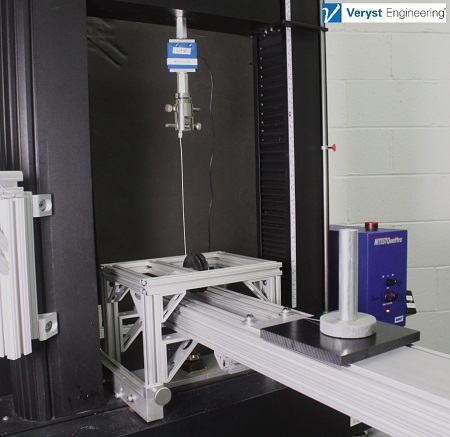
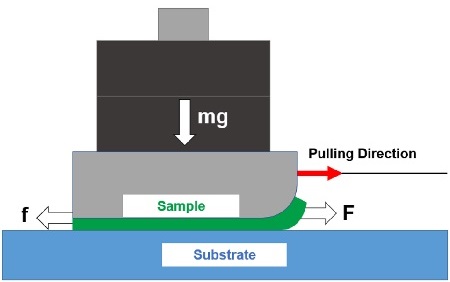
We also work with our clients to design supplementary accessories that will fit their specific needs and that are able to test even the most difficult components. Our friction testing yields data that can be used to model contact and sliding accurately in FE simulations.
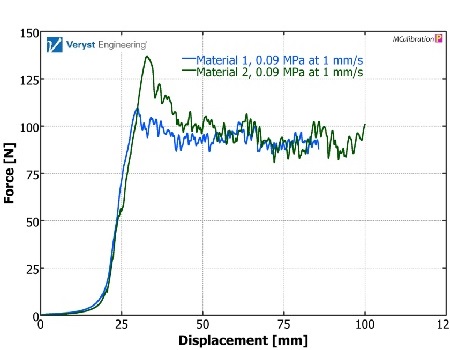
Figure 3 shows the pulling force resulting from friction tests of two different high-friction rubber materials. We performed both tests using a normal pressure of 0.09 MPa and a displacement rate of 1 mm/s. The friction force reaches a maximum value, at which point the sample begins to slide against the substrate. We calculate the dynamic and static coefficients of friction by measuring the average dynamic and maximum forces, respectively, and dividing by the normal force.
For a customized quotation, please write to us at testing@veryst.com.
We Don’t Just Deliver Solutions; We Explain the "Why" Behind Them
Browse our library of webinars, whitepapers, and blogs to learn more from our experts on advanced simulations, material modeling, and physical model validations.
Related Case Stories
Put Our Experts to the Test
Our team of scientists and engineers is ready to help you de-risk unproven technologies, explain complex material behavior, and solve your toughest product challenges.
Fractional R&D for the World’s Most Ambitious Brands
Veryst is the premier product engineering consulting firm for companies that need the highest level of confidence that their products will work in the real world.