Uniaxial Compression Testing
The uniaxial compression test is the natural complement to the tension test, frequently producing larger strains without specimen failure. Compression tests, when used in conjunction with tension tests, are useful to determine if a material exhibits asymmetry in tension versus compression. This can result from different physical reasons, including a deformation dependence on pressure. Last, some materials are more easily tested in compression due to their soft or brittle response.
Veryst recommends tests that include loading cycles and/or stress relaxation for rate-dependent materials.
Veryst has developed careful testing procedures to ensure proper lubrication between the specimen and test equipment to eliminate friction and “barreling” behavior, which can alter the state of stress in the specimen and affect the quality of the results.
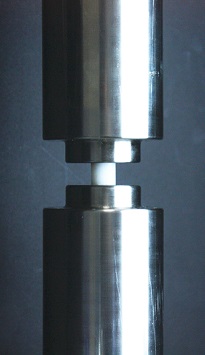
Veryst offers the following uniaxial compression tests:
- UC001 - Compression testing, monotonic to max stress/strain (i.e. ASTM D575, ASTM D695, ISO 604 etc.)
Description
A uniaxial compression test is performed at a specified strain rate. Strain is determined by measuring the local platen displacement using a clip-on extensometer or digital image correlation (DIC). Testing can be done according to ASTM D575, ASTM D695, ISO 604 or other relevant compression testing standard.
- UC002 - Compression testing, load/unload (1 strain or stress level)
Description
A uniaxial compression test is performed at a specified strain rate. The specimen is loaded to a specified strain or stress level, and then unloaded at the same crosshead speed to zero load. Strain is determined by measuring the local platen displacement using a clip-on extensometer or Digital Image Correlation (DIC).
- UC003 - Compression testing, load/unload cycles
Description
A uniaxial compression test is performed at a specified strain rate. The specimen is loaded to a specified strain or stress level, and then unloaded at the same crosshead speed to zero load. This process is repeated for the desired number of load and unload cycles at the desired strain or stress levels. Strain is determined by measuring the local platen displacement using a clip-on extensometer or Digital Image Correlation (DIC).
- UC004 - Compression testing, load/hold/unload cycles
Description
A uniaxial compression test is performed at a specified strain rate. The specimen is loaded to a specified strain or stress level, held at the specified strain or stress level for a desired amount of time (typically a few minutes) and then unloaded to zero load. This process is repeated for the desired number of load and unload cycles at the desired strain or stress levels. Strain is determined by measuring the local platen displacement using a clip-on extensometer or Digital Image Correlation (DIC).
- UC005 -Compression stress relaxation testing (up to 24 hrs.)
Description
A uniaxial compression specimen is loaded to a specified strain. The imposed strain is maintained for up to 24 hours and the stress/strain response of the material is measured. The specimen is unloaded to zero stress at the end of the specified time duration. Strain is determined by measuring the local platen displacement using a clip-on extensometer or Digital Image Correlation (DIC).
- UC006 - Compression creep testing (up to 12 hrs.)
Description
A uniaxial compression specimen is loaded to a specified stress level. The imposed stress is maintained for up to 12 hours and the stress/strain response of the material is measured. The specimen is unloaded to zero stress at the end of the specified time duration. Strain is determined by measuring the local platen displacement using a clip-on extensometer or Digital Image Correlation (DIC).
- UC007 - Custom load history
Combination of load/unload cycles and/or crosshead speeds
For a customized quotation, please write to us at testing@veryst.com.
We Don’t Just Deliver Solutions; We Explain the "Why" Behind Them
Browse our library of webinars, whitepapers, and blogs to learn more from our experts on advanced simulations, material modeling, and physical model validations.
Related Case Stories
Put Our Experts to the Test
Our team of scientists and engineers is ready to help you de-risk unproven technologies, explain complex material behavior, and solve your toughest product challenges.
Fractional R&D for the World’s Most Ambitious Brands
Veryst is the premier product engineering consulting firm for companies that need the highest level of confidence that their products will work in the real world.