Cleaner Food Processing – Without the Chemicals
“Veryst brought deep expertise in multiphase fluid mechanics that was essential to moving this project forward. Their simulations not only answered our key scientific question about the mechanism and extent of microbial inactivation, but also uncovered the ozone-reduction effect of the mist droplets – an insight with real implications for clean and safe food processing.”
– Dr. Mukund Karwe, Professor and Chair, Department of Food Science, Rutgers University
Rutgers University and Veryst partnered to unlock the science behind plasma-activated mist – an emerging chemical-free technology that uses electrically charged water droplets to kill harmful bacteria on food and food-contact surfaces.
The technology works. But a key question stood in the way of commercial scale-up: what is the source of microbial inactivation – the mist, or the surrounding air? The answer has major implications for both system design and worker safety, since the same process can generate elevated ozone levels.
Experiments alone couldn’t answer this question. So Veryst built a computational model, leveraging their core expertise in multiphase fluid mechanics (Figure 1).
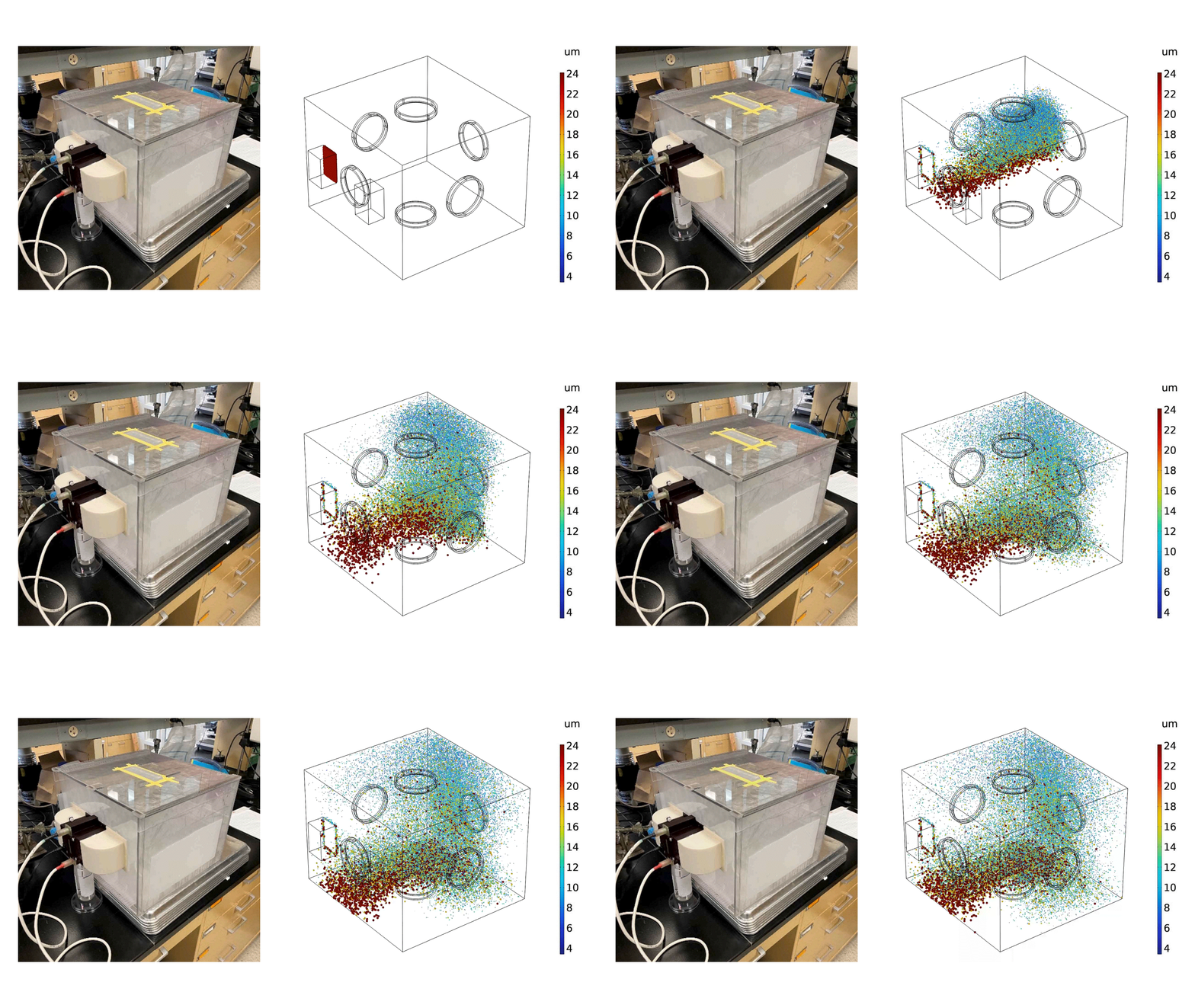
The simulation revealed a counterintuitive finding: activated molecules in the vapor – not the mist droplets – drives most of the bacterial inactivation. The droplets actually absorb ozone from the air, cutting airborne concentrations by nearly 90% – a meaningful worker safety benefit.
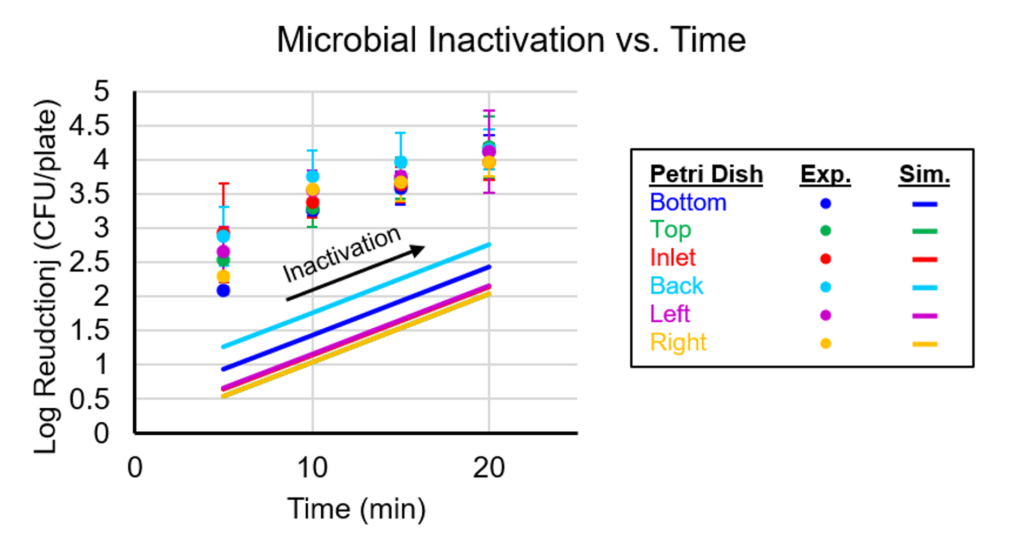
Validated against lab experiments (Figure 2), the model now gives the Rutgers team a predictive tool to optimize chamber design and accelerate the path to commercial food sanitation without costly trial-and-error.
Supported by USDA NIFA and PepsiCo, Inc. Published in Food and Bioproducts Processing (2025). The views expressed in this work are those of the authors and do not necessarily reflect the position or policy of PepsiCo, Inc.
Reference:
Eric Lorenz, Joseph M. Barakat, Sumeyye Inanoglu, Tejaswini Tumuluri, Pooja Apurva Shah, Krithi Vaidyanathan Rajan, Alireza Kermani, Mukund V. Karwe. Inactivation of Klebsiella michiganensis B199A using plasma-activated mist (PAM): Computational fluid dynamics and microbial inactivation. Food and Bioproducts Processing, 154, 879–893 (2025). https://doi.org/10.1016/j.fbp.2025.11.017