Droplet Sliding Simulation: Multiphase Flow CFD
Technical Challenge
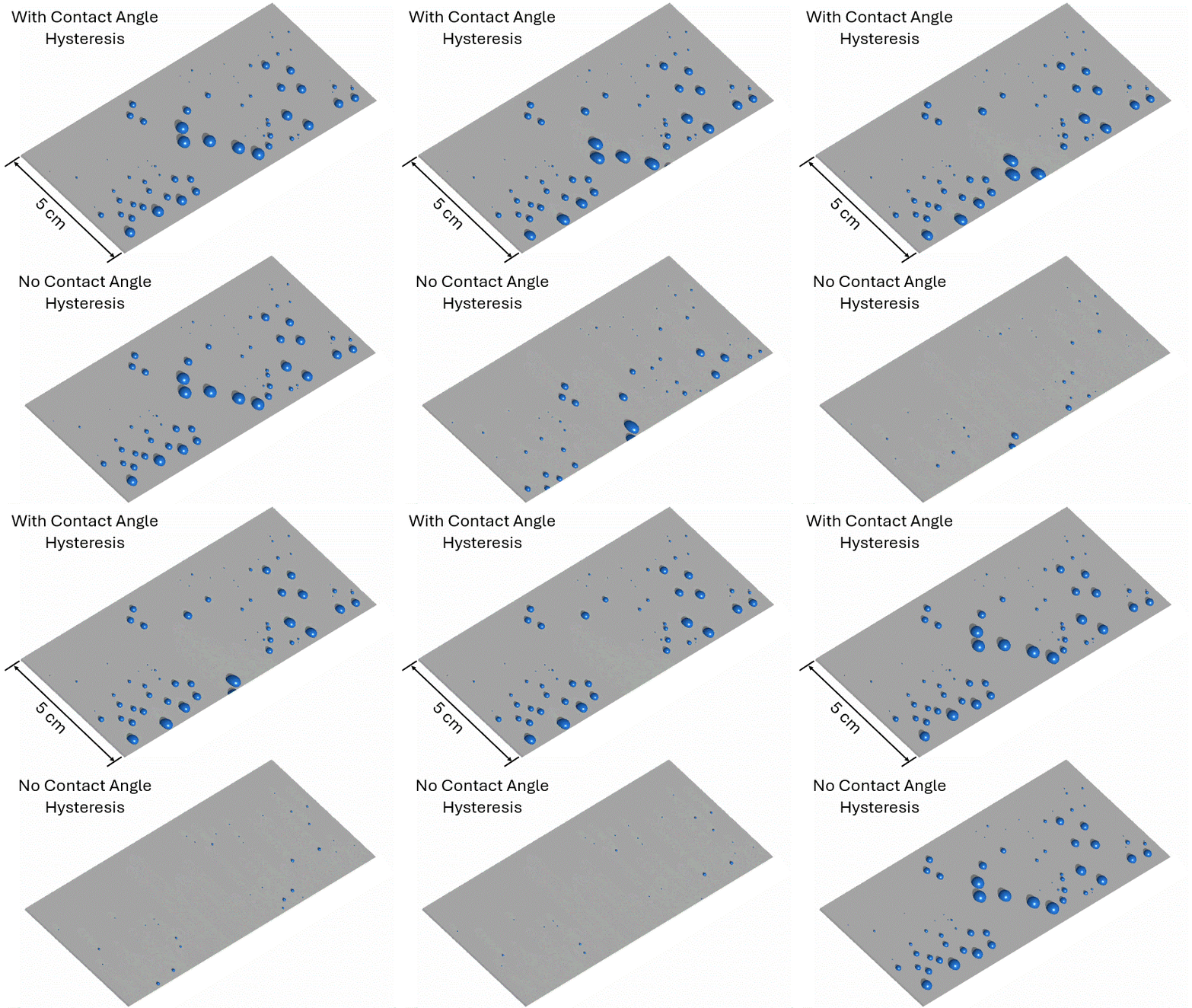
Droplets slide on or stick to inclined surfaces all the time, in nature, everyday life, and industry (Figure 1). Droplet sliding simulation lets engineers predict which will happen. Everyone understands the driving force: gravity. However, many people misunderstand the source of the resistive force: contact angle hysteresis.
Veryst Solution
The computational fluid dynamics (CFD) and microfluidics experts at Veryst developed a 3D multiphase flow droplet sliding simulation to predict whether a droplet slides or sticks on an inclined surface (Figure 1). We developed our model in COMSOL Multiphysics®. Since COMSOL does not have built-in functionality to model contact angle hysteresis, we developed this into our model via a custom implementation.
What is contact angle hysteresis?
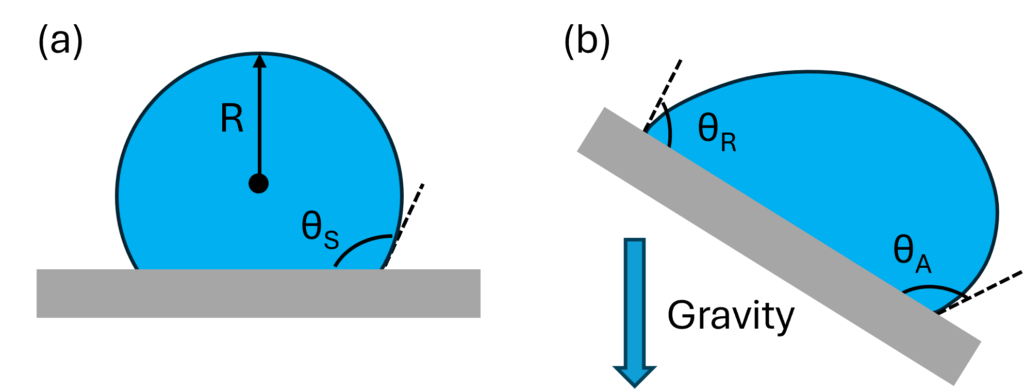
To explain contact angle hysteresis, we first review the basics of contact angles. The contact line is the perimeter of the wetted area under a droplet where liquid, air, and substrate meet. At each point on the contact line, the angle between the substrate and the droplet’s free surface (the air/liquid interface), through the liquid, is called the contact angle. On a perfectly flat, smooth, and clean (homogeneous chemistry) surface, the (theoretical) equilibrium state for a droplet is that the contact angle is constant along the contact line. We call this the static equilibrium contact angle, θS (Figure 2, a).
In practice, however, contact angle hysteresis arises when the contact line pins (gets stuck) on microscale or nanoscale surface imperfections (roughness or chemical impurities) resulting from natural processes or manufacturing. As a result, this pinning resists the driving force (gravity, air drag, electromagnetism, etc.). If this resistive force is strong enough, it can hold the droplet in place instead of letting it slide.
Specifically, for a droplet to move, the advancing portion of its contact line must have a contact angle exceeding what’s called the advancing contact angle, θA, and the receding portion of its contact line must have a contact angle that is below the receding angle, θR (Figure 2, b). Both θA and θR depend on the liquid, gas (in this case, air), and substrate surface (chemistry and roughness).
Droplet Sliding Simulation Captures the Retention Force
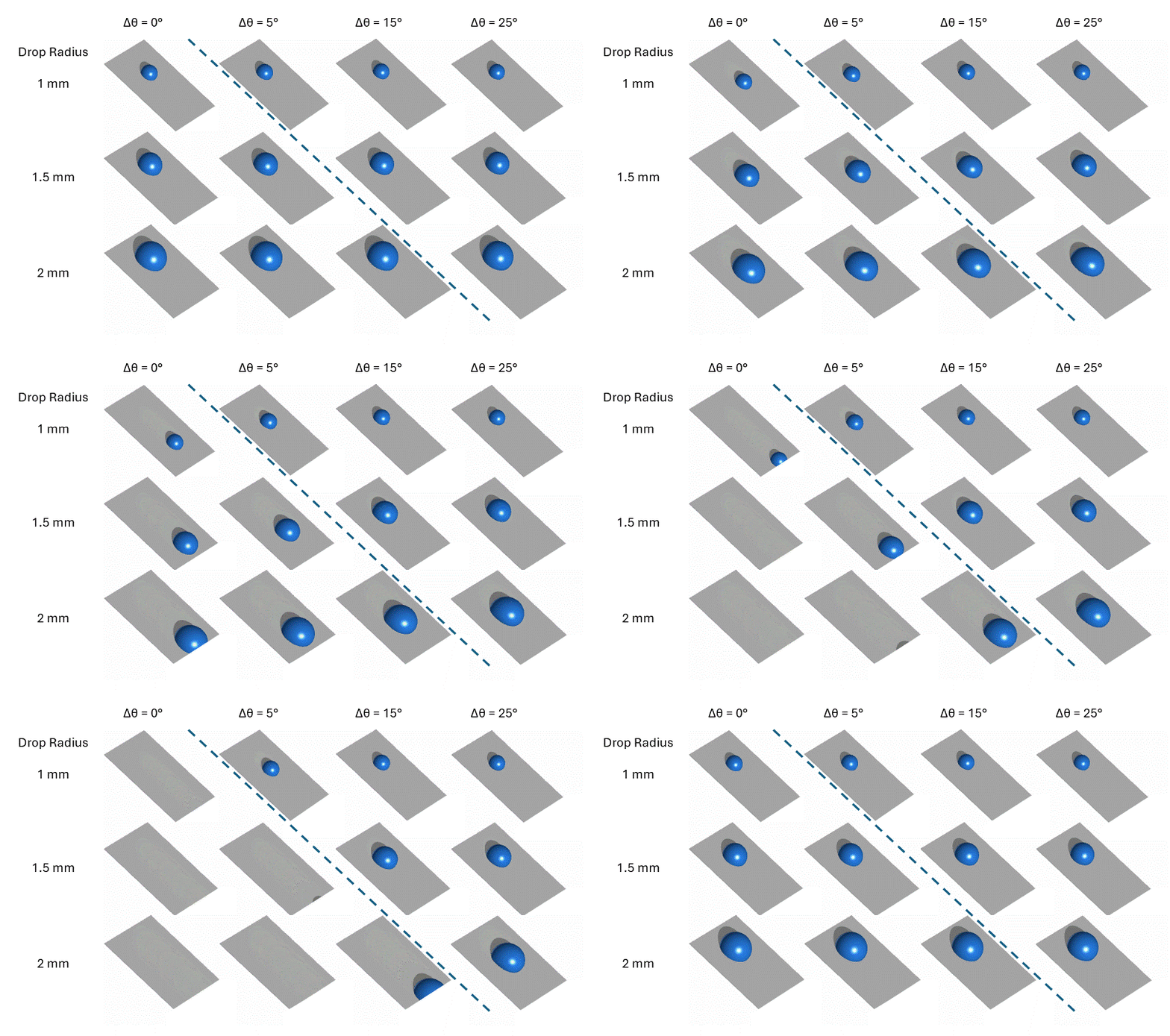
An important consequence of contact angle hysteresis is a retention force on the droplet, which scales as σr(cosθR − cosθA), where σ is the surface tension of the air-water interface and r is the droplet radius. Thus, increasing the strength of the hysteresis, Δθ = θA − θR, increases the retention force resisting the droplet’s motion. Since the force of gravity scales with the droplet volume, and hence r3, while the retention force scales linearly with r, large droplets slide while smaller droplets get pinned. Our droplet sliding simulation reproduces this relationship for different droplet sizes and levels of hysteresis (Figure 3).
Validating the Droplet Sliding Simulation
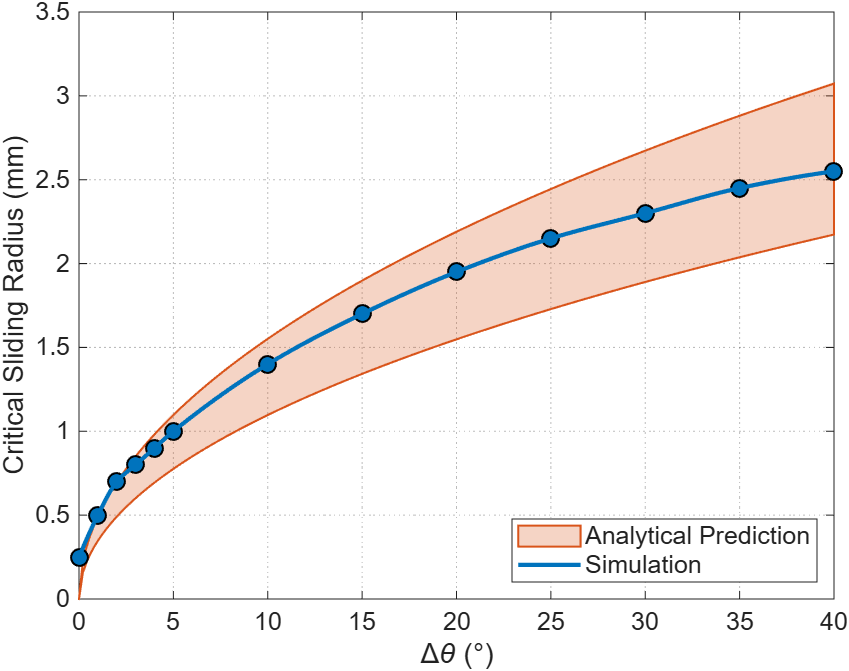
To better quantify the sliding-pinning transition, we then ran our model with different levels of hysteresis to identify the critical radius separating droplet sliding and pinning (Figure 4). Next, we compare our results to Furmidge [1]’s semi-analytical prediction that includes a tunable constant with reported ranges in the literature (Figure 4, shaded band). Our simulation results fall within this band across the full range of hysteresis Δθ values tested, which validates our model.
Conclusion
Our droplet sliding simulation captured the physics of sliding and pinning on inclined surfaces using high-fidelity multiphase CFD simulations. Our validated results demonstrate the dependence of the critical sliding radius on contact angle hysteresis. Overall, the model serves as a predictive tool for anticipating droplet sliding and pinning behavior, supporting a wide range of industrial applications.
References
[1] Furmidge, C. V. “Studies at phase interfaces. I. The sliding of liquid drops on solid surfaces and a theory for spray retention.” Journal of Colloid Science 17, no. 4 (1962): 309–324.