Functional Inkjet Printing Simulation: Multiphase Flow CFD
Technical Challenge
Functional inkjet printing involves depositing micro-scale droplets onto a substrate to build features, a key manufacturing step across a wide range of industries. Printing performance depends on the accuracy and precision of the feature shape achieved. In printed electronics, droplets merge into smooth, continuous conductive traces that form RFID antennas and flexible circuit interconnects. Inkjet-based additive manufacturing builds parts layer by layer from coalescing droplets, and the film cross-section governs dimensional accuracy and strength. MedTech applications include depositing reagents and biomolecules for diagnostic devices and patterning cell-laden bioinks into scaffolds for tissue engineering constructs.
Across these applications, how a sequence of droplets coalesces and then evolves before curing determines the printed feature’s shape. Several coupled mechanisms make that shape hard to predict. First, when a droplet contacts the substrate or an existing film, its impact velocity drives a brief, energetic inertial phase. After that, viscous damping and surface-tension-driven flow govern how the film evolves. Each new droplet also launches a capillary wave that deforms the film as it travels. Because the film typically solidifies before viscosity fully damps these waves, the final shape depends on ink formulation, substrate properties, droplet size, ejection frequency, and spacing.
Experiments reveal the quality of a finished feature but little about the dynamics that produced it. In contrast, physics-based simulation resolves the full time-dependent shape evolution, showing engineers how printing, material, and curing parameters shape the final feature without a full experimental campaign for every new ink, substrate, or printing profile.
Veryst Solution
The computational fluid dynamics (CFD) and microfluidics experts at Veryst extended our validated single-droplet deposition model to predict the printing of a sequence of impacting, spreading, and coalescing droplets. In this study, we focus on droplet impact, coalescence, and film evolution on a solid substrate. The framework can be extended to include additional substrate physics, such as absorption into porous materials.
Model Setup
In our simulation, we release each droplet above the substrate with a prescribed velocity toward it, then follow its trajectory, impact, and coalescence with the evolving film. We implemented the model in COMSOL Multiphysics® using a phase-field multiphase flow formulation coupled with a Navier-slip boundary condition at the substrate to capture the motion of the advancing contact line and the evolution of the film profile. The ink is a water-modified PEDOT:PSS formulation [1]. The material and printing parameters are in the standard printable-fluid regime for drop-on-demand inkjet printing [2].
Film Profile Evolution for Different Droplet Distributions
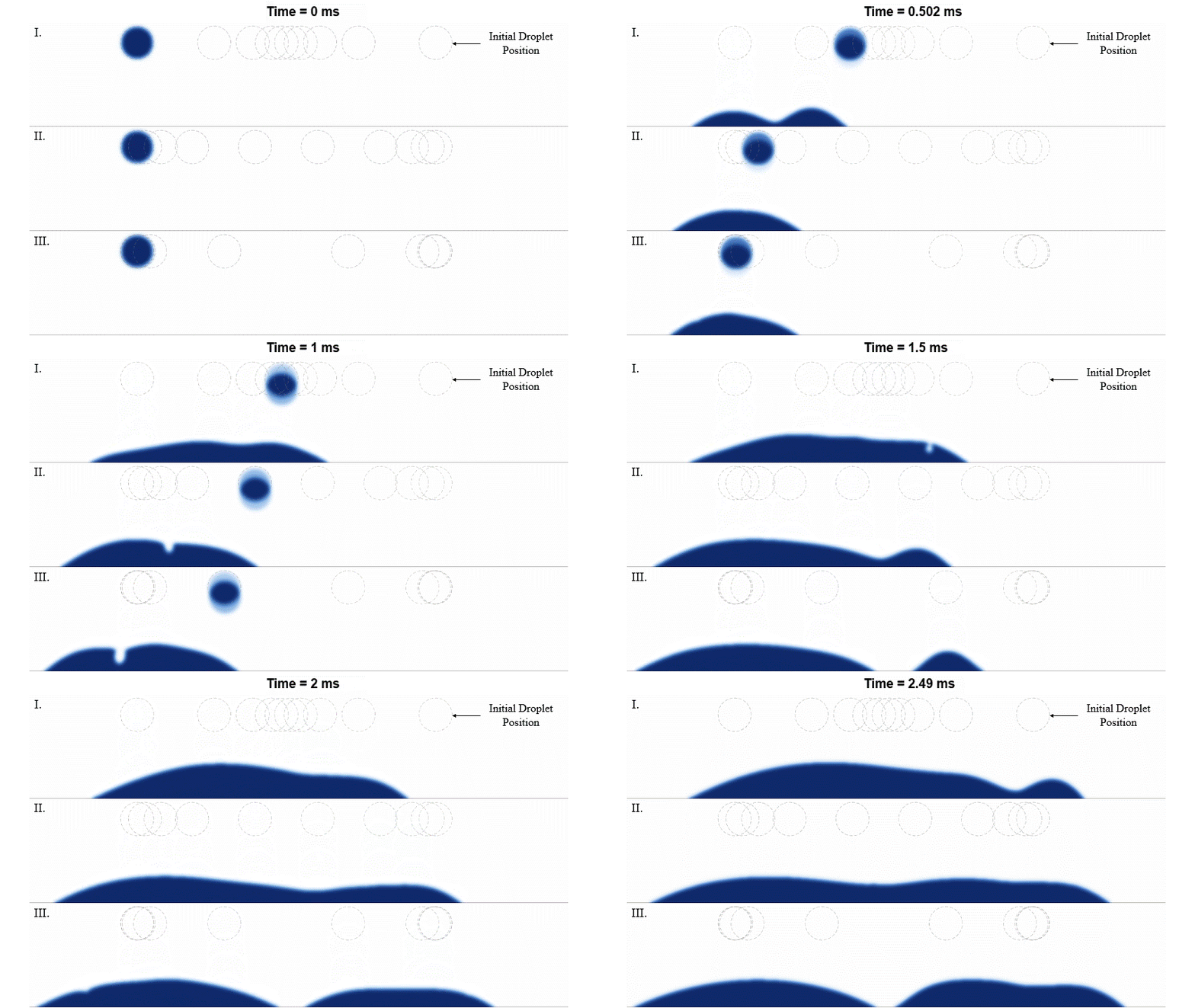
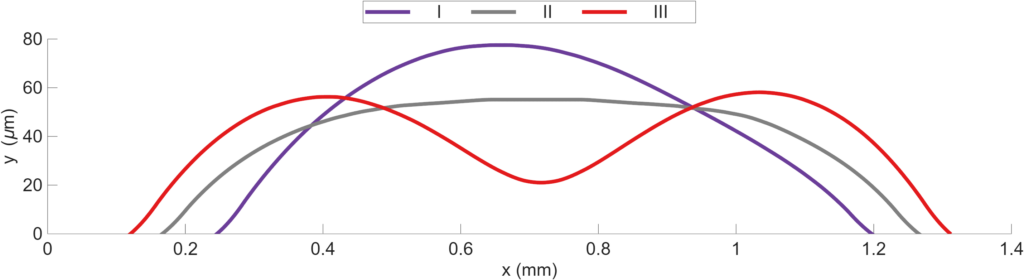
Figure 1 shows the film profiles that result from different initial droplet distributions. In case I, we concentrate droplets near the film center. They coalesce almost immediately, while the more sparsely spaced droplets near the edge coalesce later, producing a film that is thicker at the center and tapers toward the perimeter. The other cases place progressively more droplets near the perimeter. In case II, droplets near the perimeter coalesce quickly, while the wider gaps near the center slow coalescence, producing a shallower film at the center. In case III, wider interior spacing produces two disconnected liquid films, which spread and eventually merge.
Final Film Profiles
In inkjet-based additive manufacturing, films often relax briefly before partial or full curing. Here, we allow 2.5 ms of relaxation. Figure 2 shows the film profiles at 5 ms, demonstrating their dependence on the initial droplet distribution.
Conclusion
Veryst’s multiphase CFD simulations capture the dynamics of droplet impact, coalescence, and film evolution in functional inkjet printing. The results show how the final film profile depends on the initial droplet distribution. The same framework can be extended to examine other factors that govern feature shape, including substrate wettability and porosity, thermal gradients, and curing kinetics. As a predictive tool, the model supports optimization of printing and material parameters across printed electronics, additive manufacturing, and reagent and biomaterial printing for diagnostic and medical devices.
References
[1]. Hrehorova, E.; Rebros, M.; Pekarovicova, A.; Fleming, P.D.; Bliznyuk, V.N. (2007). Characterization of conductive polymer inks based on PEDOT:PSS.
[2]. Lohse, D. (2022). Fundamental Fluid Dynamics Challenges in Inkjet Printing. Annual Review of Fluid Mechanics, 54, 349–382. https://doi.org/10.1146/annurev-fluid-022321-114001