Technical Challenge
Inkjet printing has emerged as a versatile and scalable deposition technology across a growing range of high-precision manufacturing applications. In printed electronics, inkjet deposition enables the direct fabrication of conductive traces, dielectric layers, and active device components onto substrates. In diagnostic device manufacturing, the same technique is used to deposit reagents, including antibodies and detection agents, onto substrates, where the size and uniformity of each deposited spot directly affect assay performance. In both settings, the precision of the finished device ultimately depends on how an individual inkjet droplet spreads upon contact with the substrate, as the maximum spread diameter directly governs the printed feature size.
However, the dynamics of an impacting droplet on a solid substrate are far from straightforward. Upon impact, a droplet can exhibit complex
behavior including rim formation, partial rebound, and air entrainment. Most critically, the motion of the contact line — which governs the maximum spread diameter — is sensitive to the interplay between the ink's surface tension and viscosity and the wettability of the substrate. Small changes in any of these parameters can significantly change the deposited feature size, compromising the precision of the final device. Experimental characterization is possible but costly, as each change in substrate material or ink formulation demands a new test campaign. In addition, empirical approaches alone rarely provide the mechanistic insight needed to diagnose printing failures. Physics-based simulation of droplet impact and spreading offers a practical alternative, enabling rapid predictions across a wide range of ink and substrate combinations without repeated physical trials.
Veryst Solution
The computational fluid dynamics (CFD) and multiphase flow experts at Veryst developed high-fidelity simulations to predict droplet impact and spreading on a solid substrate. In the simulation, a liquid droplet with prescribed downward velocity impacts the substrate. To capture the complex motion of the advancing contact line, we employed a multiphase flow formulation coupled with a Navier-slip boundary condition at the solid substrate.
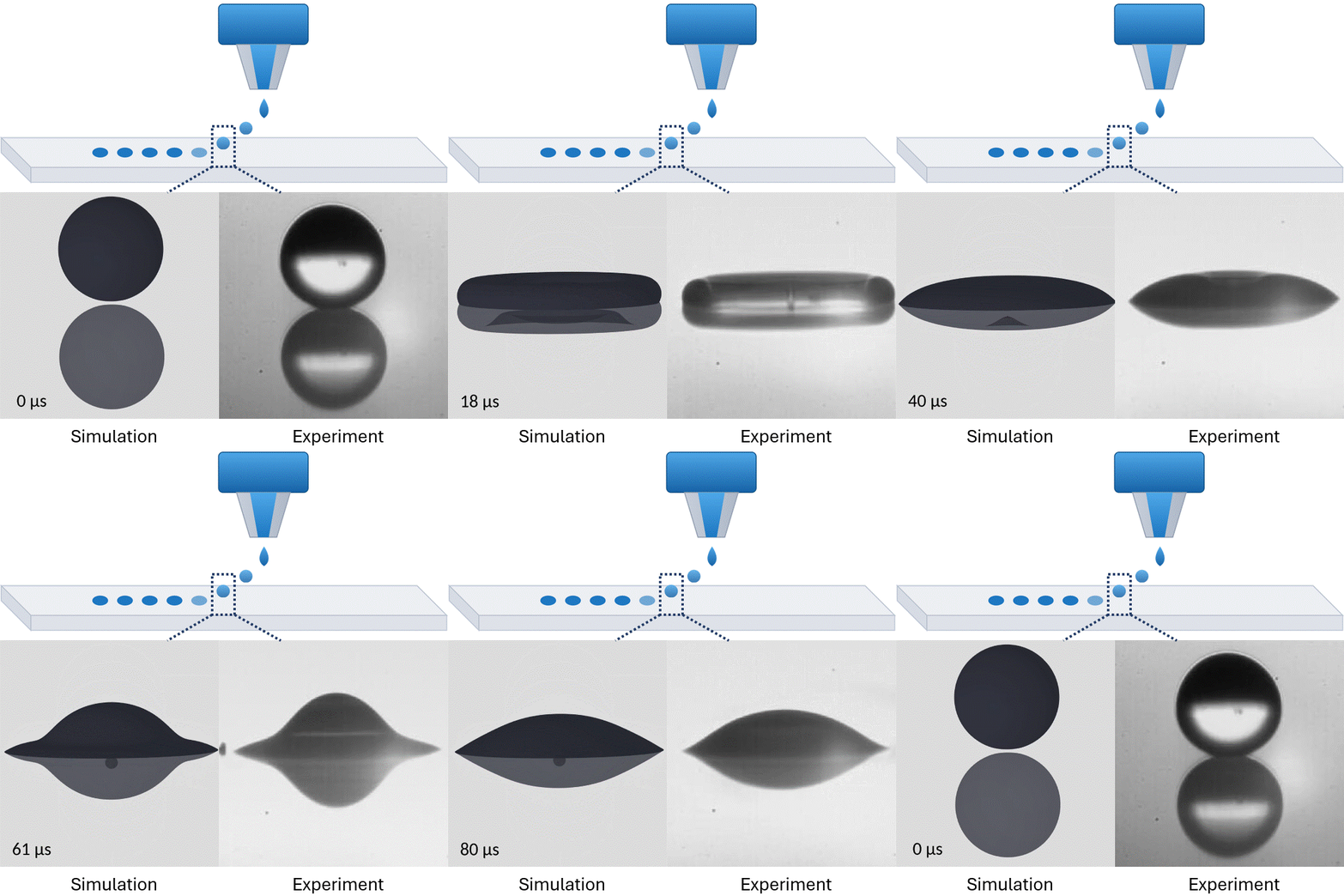
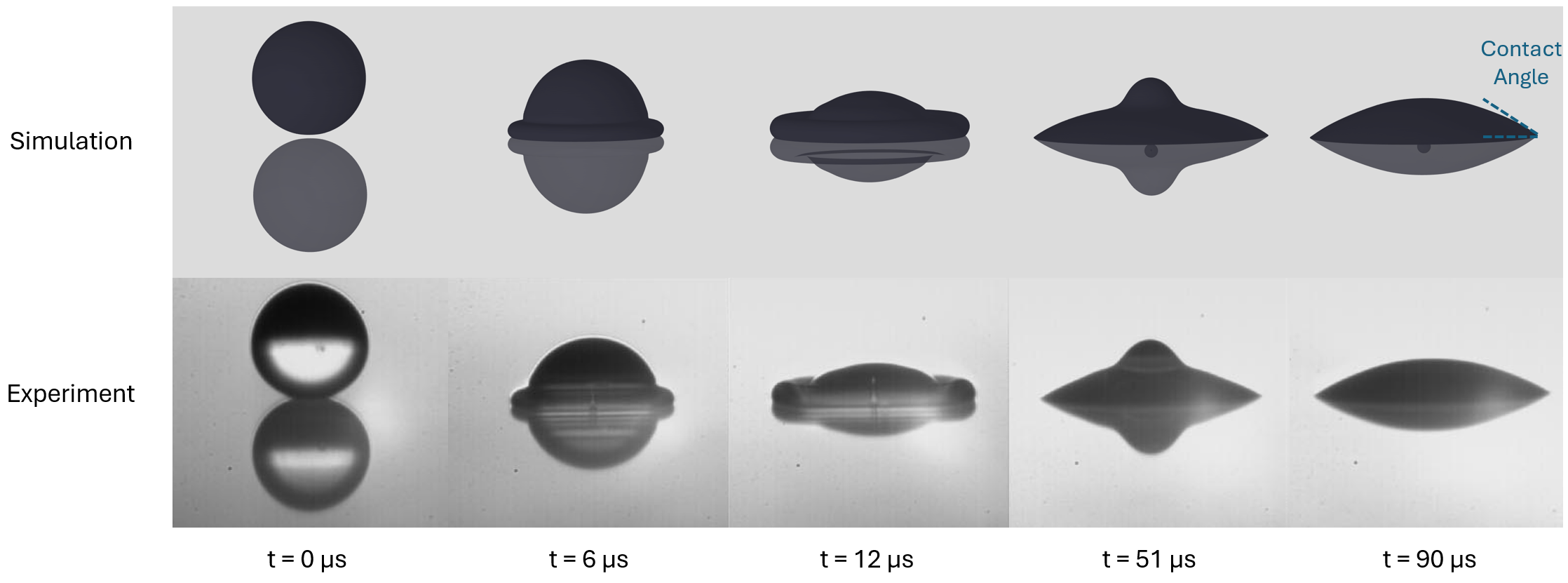
In Figures 1 and 2, we show our droplet impact simulation results validated against an experiment from literature [1]. The simulation closely reproduces the experimental observations, capturing the key stages of the impact process. Immediately upon contact, the droplet undergoes rapid radial spreading as kinetic energy drives the liquid outward, forming a thin lamella and a raised rim at the advancing contact line. The spreading diameter approaches its maximum at approximately t = 21 μs, at which point the rim structure is clearly visible at the droplet periphery. At later times, surface tension forces overcome the outward inertia of the spreading front, and the droplet transitions from spreading to retraction. By t = 90 μs, the droplet has settled into a lens-like equilibrium shape consistent with substrate wettability (contact angle 35°).
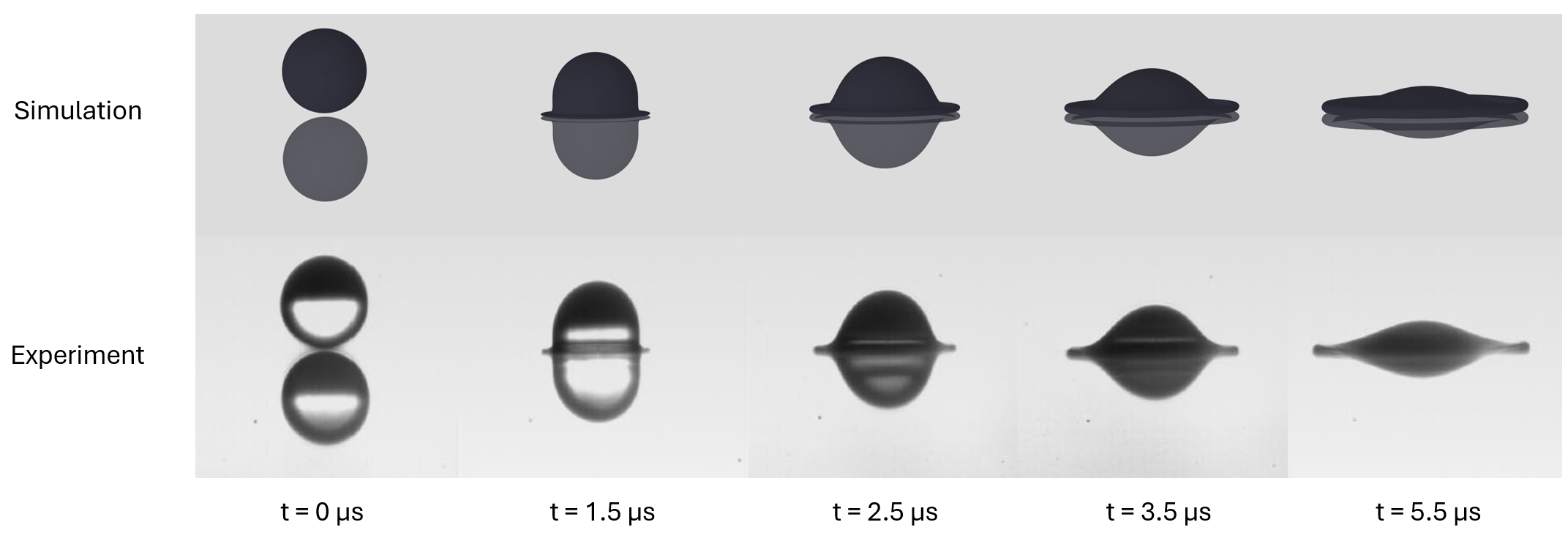
To further validate the simulation, we examine a second droplet impact with higher impact velocity and more wettable substrate. (Figure 3). The simulation again closely reproduces the experimental results throughout the impact process. Upon contact, a thin lamella shoots rapidly outward from the droplet base while the central mass retains a domed profile, a behavior characteristic of high-inertia impact. The combination of elevated kinetic energy and strong substrate wettability drives substantially more aggressive spreading compared to the previous case, and by t = 5 μs the droplet has collapsed into a thin, laterally extended profile with a spread diameter well exceeding the initial droplet diameter.
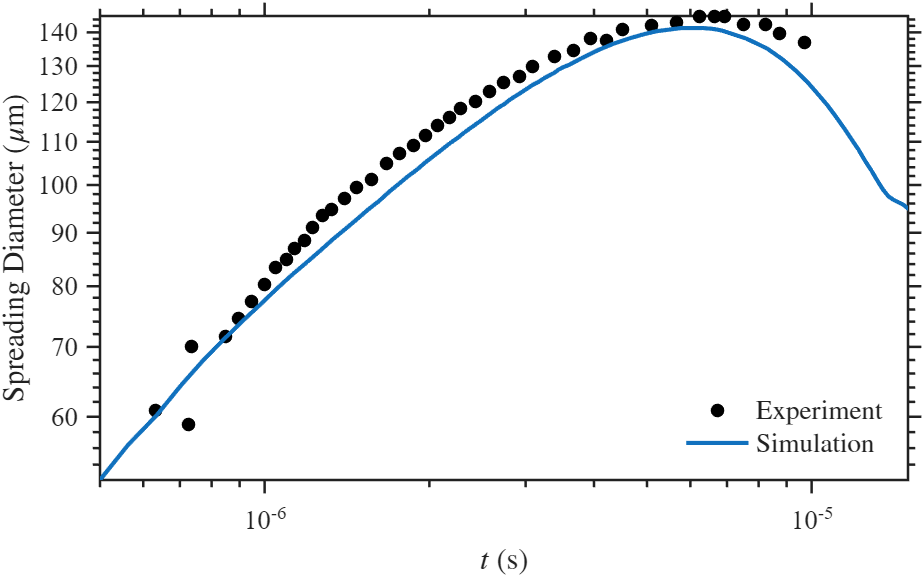
A third validation case is shown in Figure 4, where we compare the time-dependent droplet spreading diameter to experimental measurements [2]. The simulation accurately captures the spreading dynamics throughout the phases of spreading: inertial, retraction, and steady-state. In the inertial phase, the droplet spreads outward to a maximum and then retracts, gradually evolving to steady-state.
[1]. D. B. van Dam and C. Le Clerc, "Experimental study of the impact of an ink-jet printed droplet on a solid substrate," Phys. Fluids 16, 3403–3414 (2004), https://doi.org/10.1063/1.1773551.
[2]. C. W. Visser, P. E. Frommhold, S. Wildeman, R. Mettin, D. Lohse and C. Sun, "Dynamics of high-speed micro-drop impact: numerical simulations and experiments at frame-to-frame times below 100 ns," Soft Matter 11, 1708–1722 (2015).