Case Studies

Golf Ball Impact Simulation

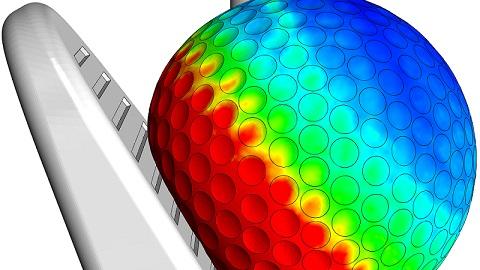
Accurate simulation of golf ball behavior during impact with a club is challenging due to the nonlinear impact event, the complexity of the polymeric ball material at the high strain rates experienced during impact, and the scarcity of material properties at these high strain rates. Veryst Engineering developed an accurate model that accounts for these complexities.
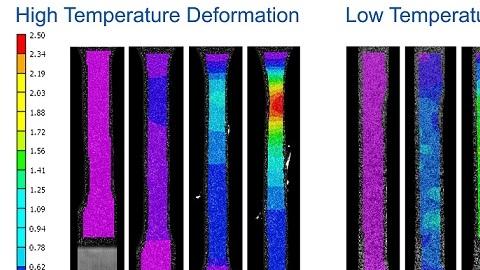
High Rate Temperature Response of Polymers

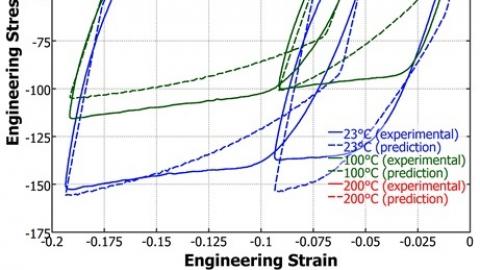
Polymers exhibit significant temperature-dependent mechanical response. Veryst tested a PEEK material at multiple temperatures and calibrated the PolyUMod® Three Network (TN) material model for finite element simulation.

High Strain Rate Testing of Fiber-Reinforced Thermoplastics

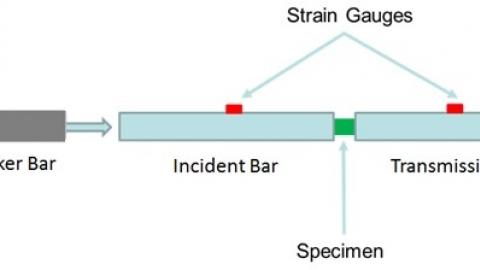
Understanding composite materials’ impact response as a function of fiber direction is important for a wide range of uses, from automotive applications for crashworthiness to consumer product uses for drop and impact resistance. Veryst evaluated the high strain rate response of both glass fiber and carbon fiber reinforced PEEK (polyether ether ketone) using the Split Hopkinson Pressure Bar test method.

High Strain Rate Testing of Polymers

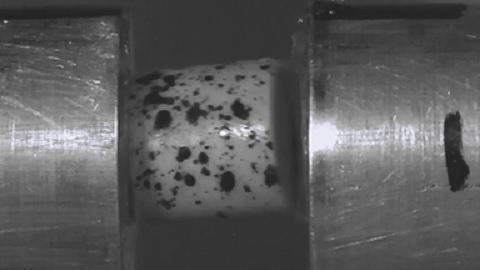
This case study demonstrates the testing and calibration of a polycarbonate material at a high strain rate of 1000 sec-1. The testing was done with the Split Hopkinson Pressure Bar (SHPB) system and the calibration is performed with the MCalibration® software, originally developed by Veryst Engineering.

LED Light Bulb Heat Transfer Simulation

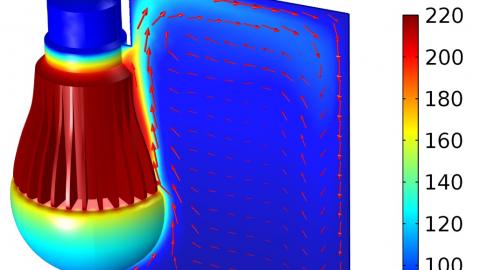
Both the efficiency and life of an LED bulb drop when operated at high temperature. Given the wide range of possible shapes and sizes of heat sinks, Veryst Engineering developed a rapid and effective tool to compare design alternatives and estimate LED temperatures.

Material Models for Hot Forging Simulation

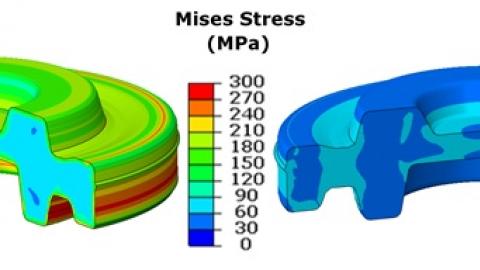
Hot forging simulations depend critically on the correct selection of metal material models. Veryst illustrates this dependence through a turbine disk forging simulation using both rate-dependent and rate-independent material models.

PEEK Temperature Dependence

PEEK materials are increasingly used in a variety of industries with elevated temperature applications. This example shows how Veryst Engineering developed a temperature-dependent, nonlinear model of PEEK behavior for use in commercial FEA codes.

Peeling of a Soft Polymer Film

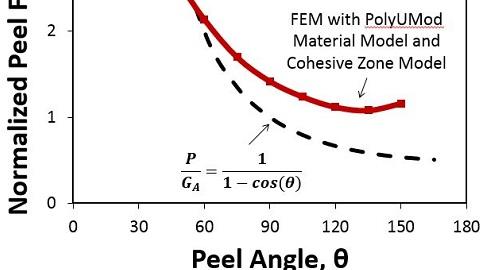
The peel test is widely used to measure the adhesion of thin, compliant films to rigid substrates. An accurate model of the peeling mechanics is required to extract the interface adhesion energy. Veryst used the PolyUMod® material model library along with a cohesive zone model of interface adhesion to simulate the peeling of a soft viscoplastic film from a rigid substrate.

Polymer Foam Testing & Modeling

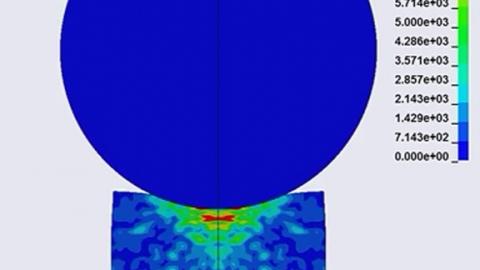
Polymer foams may exhibit extreme strain rate-dependence due to their structure. The low stiffness means testing the materials at high strain rates is particularly difficult. Veryst has developed multiple test methods to test and model these materials.

Can we help? Just want to keep in touch?