Technical Challenge
Vial filling—the high-speed transfer of liquids into vials under controlled conditions—is a common process step in pharmaceutical, diagnostic, and laboratory applications, where product quality and regulatory compliance demand exceptional consistency and reliability. This case study explores the role that flow rate plays on filling dynamics, showing that different
flow rates give rise to qualitatively distinct regimes—from gentle dripping to plunging jets with pronounced air entrainment. In a separate case study, we explore the role of nozzle motion. These results provide practical guidance for engineers seeking to refine filling protocols, minimize waste, and ensure consistently reliable production.
Veryst Solution
The computational fluid dynamics (CFD) experts at Veryst developed advanced multiphase flow models to simulate vial filling with a stationary nozzle to quantify how nozzle flow rate controls filling dynamics such as dripping, splashing, and air entrainment.
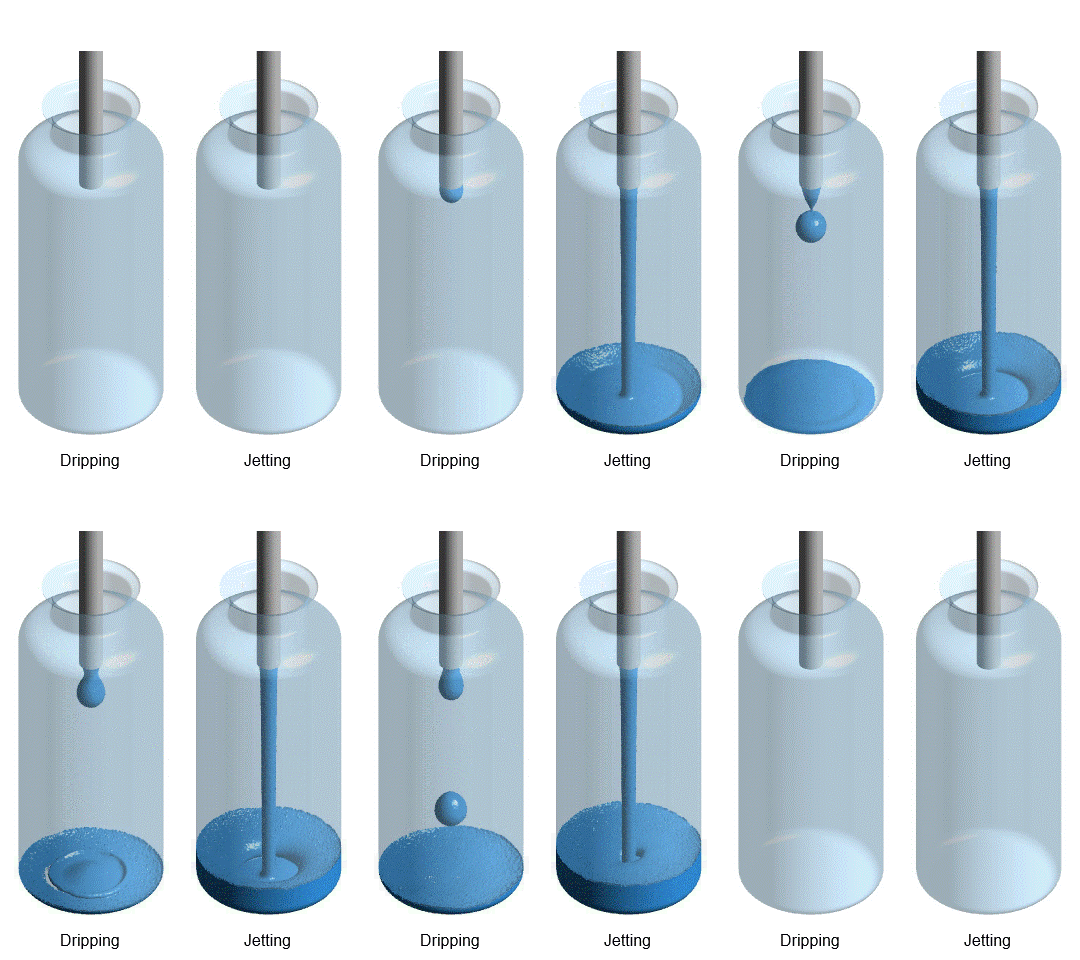
In the simulation, water is introduced through a fixed nozzle into a vial initially filled with air, and the inlet flow rate is varied between a low value that produces dripping (Figure 1, left) to a higher value that produces jetting (Figure 1, right).
When the flow rate is sufficiently low (Figure 1, left), inertia is insufficient to form a continuous jet; gravitational and interfacial forces dominate the motion, leading to the periodic formation and detachment of droplets (interested to learn more? See our droplet formation case study). Once detached, the droplets accelerate downward, strike the vial bottom, and break into smaller satellite droplets, producing a complex three-dimensional flow pattern.
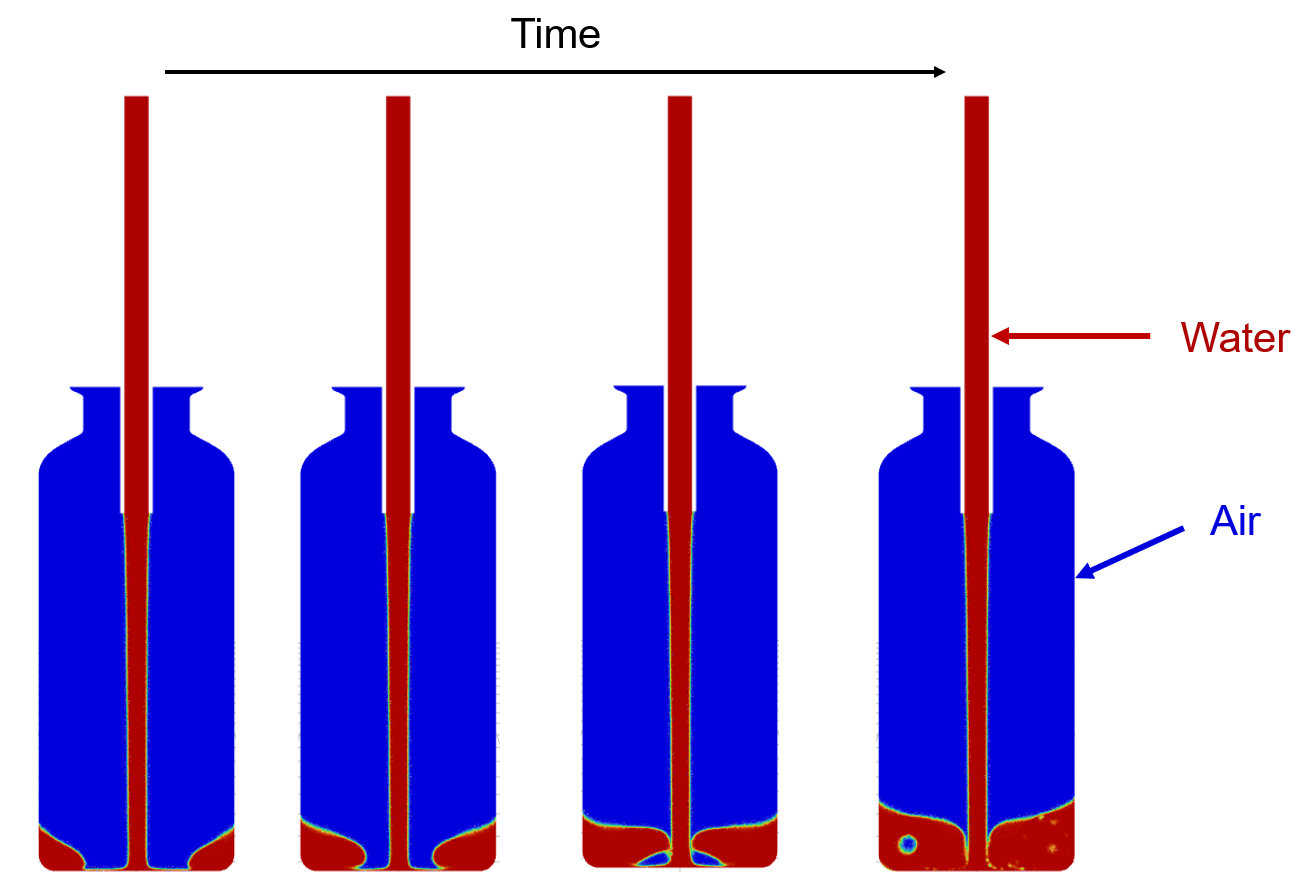
If the flow rate is sufficiently high (Figure 1, right), inertia overcomes surface tension, resulting in a coherent jet. This jet impacting the free surface introduces localized turbulence at the point of entry, where the high-momentum jet rapidly displaces the surrounding fluid, leading to a more complex flow pattern. The plunging jet also entrains discrete pockets of air into the liquid. As illustrated in Figure 2, jet initially impinges on the bottom wall, displacing liquid radially outward and raising the liquid level preferentially near the sidewalls. As the fill continues, fluid near the walls flows back toward the center, creating a recirculating region where an isolated air pocket becomes trapped and subsequently advected and stretched by the surrounding flow, inducing vigorous internal mixing.
Conclusion
Using high-fidelity multiphase CFD simulations, Veryst captured the distinct interfacial dynamics that arise during vial filling, from dripping-driven impacts to plunging jets with splashing and air entrainment. By revealing how changes in flow rate affect fill quality, these results offer actionable guidance for optimizing nozzle motion, flow-rate control, and operating conditions to achieve clean, stable fills while minimizing undesirable behavior. Such simulations equip engineers with the insight needed to refine and improve drug manufacturing protocols, supporting robust, precise, and scalable production satisfying regulatory guidelines.