Case Studies

Concentration Gradients in Microfluidic Devices

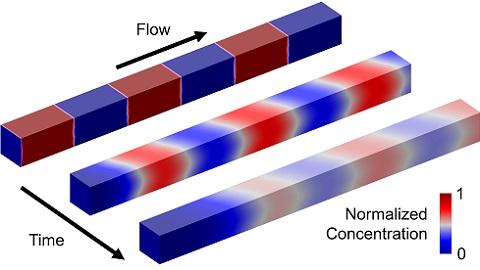
Controlling spatial variations in chemical concentration is important for designing and operating many microfluidic devices across a wide range of industries and applications including diagnostics, genomics, and pharmaceutics. In this case study, we show how simulations may be used to quantify and control concentration gradients in microfluidic devices.

Delamination in Microfluidic Valves

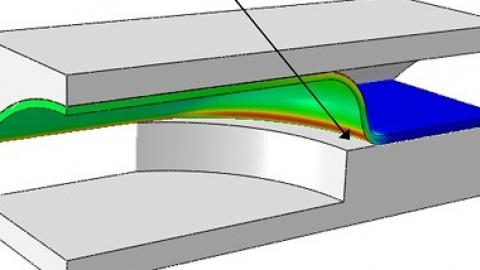
A commonly encountered failure mode in microfluidic devices is delamination between adjacent device layers. Veryst examined the influence of control channel geometry on the delamination pressure of a pneumatic microfluidic valve using finite element analysis.

Design and Simulation of a Catheter-Based Acoustic Ablation Device

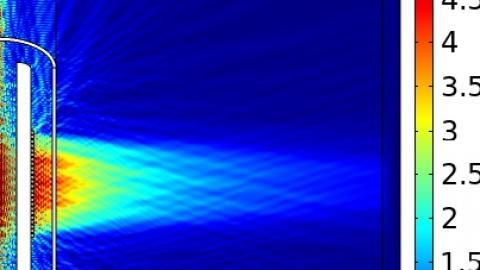
Thermal ablation is a minimally invasive way to treat tumors, and simulating the physics of ablation can help in the design of ablation devices. Veryst designed and simulated a catheter-based acoustic ablation device relying on acoustic pressure waves to heat tissue to induce necrosis.

Designing MEMS Gyroscopes for Manufacturing

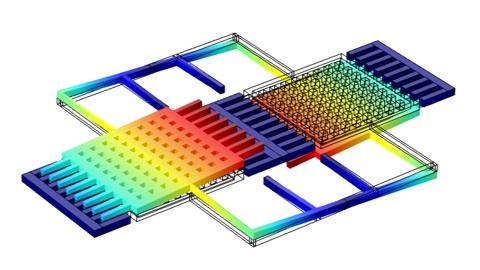
Manufacturing variations are of critical importance in MEMS design. In this MEMS gyroscope case study, Veryst created an approach to look at the effect of a range of manufacturing variations on MEMS devices using the same mesh. We also use semi-analytic equations to enable scalable modeling of the gyroscope electrostatic actuation and pick-off (which senses the motion produced by rotation).

Eddy Current Based Axial Magnet Coupling

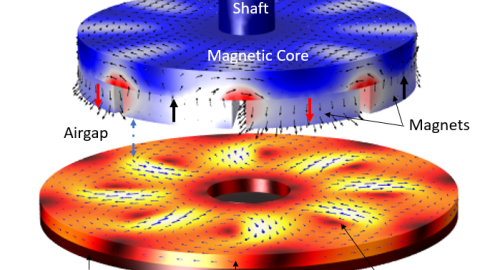
Eddy current-based magnetic couplings are non-contact devices that utilize the interaction between induced eddy currents and magnetic fields to transmit torque between a driver and a load. Veryst employed finite element analysis (FEA) to model the intricate behavior of these couplings, optimizing their performance for efficient and smooth torque transmission.

Equation-Based Modeling of Thin Shells for Electromagnetic Simulations

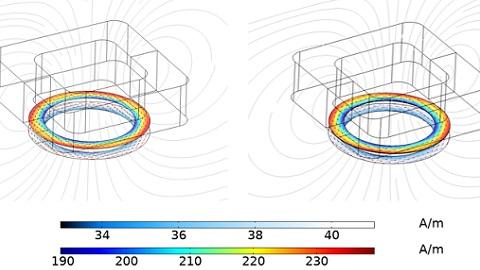
For several of the electromagnetics interfaces provided with COMSOL Multiphysics, a single layer shell feature, the “Transition Boundary Condition,” is available. Veryst created custom expressions to extend this feature for multiple layers. In this case study we discuss the implementation of this new functionality, and the advantages of using such shells for electromagnetic modeling.

FEA of Absorbable PLLA Bone Screw

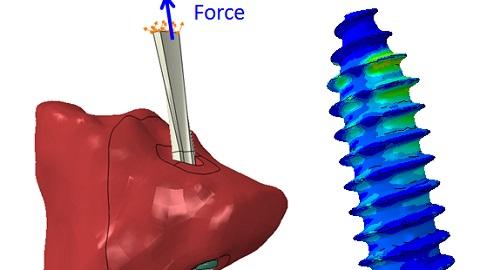
The nonlinear deformation and material relaxation associated with modeling the polymer screws for anterior cruciate ligament (ACL) reconstruction makes predicting key quantities such as stresses and holding forces challenging. Veryst, with its unique ability to test and model PLLA materials, was able to develop material and finite element models that predict the important short-term pull-out forces as well as the evolution of stresses over time.

Fluid Flow Through Porous Media

Quantifying the rate of fluid flow through a porous matrix is important in many applications, including diagnostic devices, inkjet printing, textile fabrication, soil and groundwater remediation, and energy storage. In this project, Veryst used computational fluid dynamics to predict the transient rate of capillary imbibition through paper-based devices of varying geometry to help the client achieve the desired flow rate time profile for their fluidic device.
Golf Ball Impact Simulation

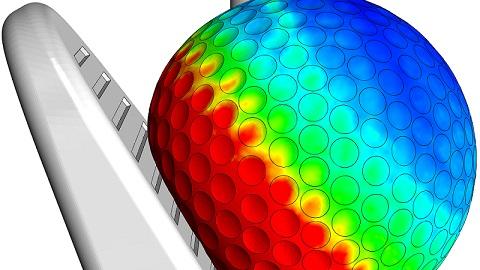
Accurate simulation of golf ball behavior during impact with a club is challenging due to the nonlinear impact event, the complexity of the polymeric ball material at the high strain rates experienced during impact, and the scarcity of material properties at these high strain rates. Veryst Engineering developed an accurate model that accounts for these complexities.

Can we help? Just want to keep in touch?