Non-isothermal Flows
Modeling convective flow requires coupling fluid-flow with heat transfer. The coupled processes can be very complex, particularly if the fluid flow is turbulent, or if the heat transfer involves processes such as boiling, evaporation, or mixed fluids with varying thermal properties. For each convective flow problem we first identify the heat transfer and flow characteristics and reduce model complexity where possible. This includes using analytical heat transfer equations instead of explicitly modeling parts of the fluid, using the Boussinesq approximation to reduce model nonlinearity in natural convection, and using approximate formulations to model cavity radiation.
Example: LED Light Bulb Heat Transfer
The efficiency and life of an LED will drop when operated at high temperature. LED manufacturers design heat sinks with cooling fins into the body of the bulb to reduce the operating temperature. Given the wide range of possible shapes and sizes of heat sinks, a rapid and effective tool is needed to compare design alternatives and estimate LED temperatures.
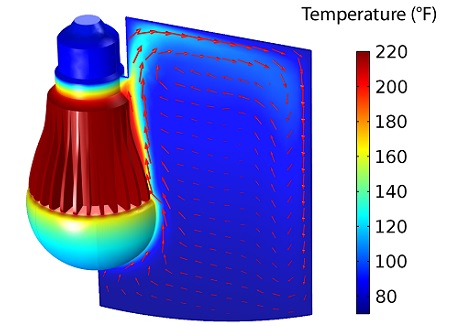
Veryst developed a conjugate heat transfer finite element model of an LED bulb and surrounding air in an enclosed recessed lighting fixture. Conduction between the LEDs and the bulb body, natural convection in the surrounding air, and radiation between surfaces were included to predict accurately the temperature of the LEDs. For more details, see LED Light Bulb Heat Transfer Simulation
We Don’t Just Deliver Solutions; We Explain the "Why" Behind Them
Browse our library of webinars, whitepapers, and blogs to learn more from our experts on advanced simulations, material modeling, and physical model validations.
Related Case Stories
Put Our Experts to the Test
Our team of scientists and engineers is ready to help you de-risk unproven technologies, explain complex material behavior, and solve your toughest product challenges.
Fractional R&D for the World’s Most Ambitious Brands
Veryst is the premier product engineering consulting firm for companies that need the highest level of confidence that their products will work in the real world.